 SG
SG  VN
VN 

From Bubbles to A's: Using Digital Incentives to Solve the 'Motivation' Problem
From Bubbles to A's: Using Digital Incentives to Solve the 'Motivation' Problem
Getting a child to consistently open their assessment books without prompting can feel like a daily battle. Digital incentives built into today's online tuition platforms tackle this head-on by using gamified rewards to create positive feedback loops, turning academic effort into tangible recognition. This approach isn't just about making learning fun, it’s a structured system designed to build the kind of consistent study habits that lead to real academic progress, a method that gained significant traction after the 'heightened alert' phases pushed many families towards digital learning solutions.
How Digital Rewards in Online Tuition Actually Work
At its core, a digital incentive system is based on a simple principle: effort equals reward. Think of it like a digital version of a sticker chart, but far more sophisticated. When a student completes a set of AI-generated practice questions or masters a new topic in a live class, the platform instantly recognises that achievement with a form of digital currency, be it 'points', 'gems' or 'bubbles'. This system operates on the principles of behaviorist reinforcement, creating a direct and immediate link between positive action and reward.
This digital currency can then be used in a virtual store to 'buy' things. They consist of both physical and digital rewards that matter in a child's digital world:
- Custom Avatars: Letting them personalise their online identity.
- Virtual Items: Decorating a virtual space or collecting rare items.
- Physical Items: Items that are available on virtual stores delivered to their home.
- Badges and Leaderboards: Offering public recognition for their achievements.
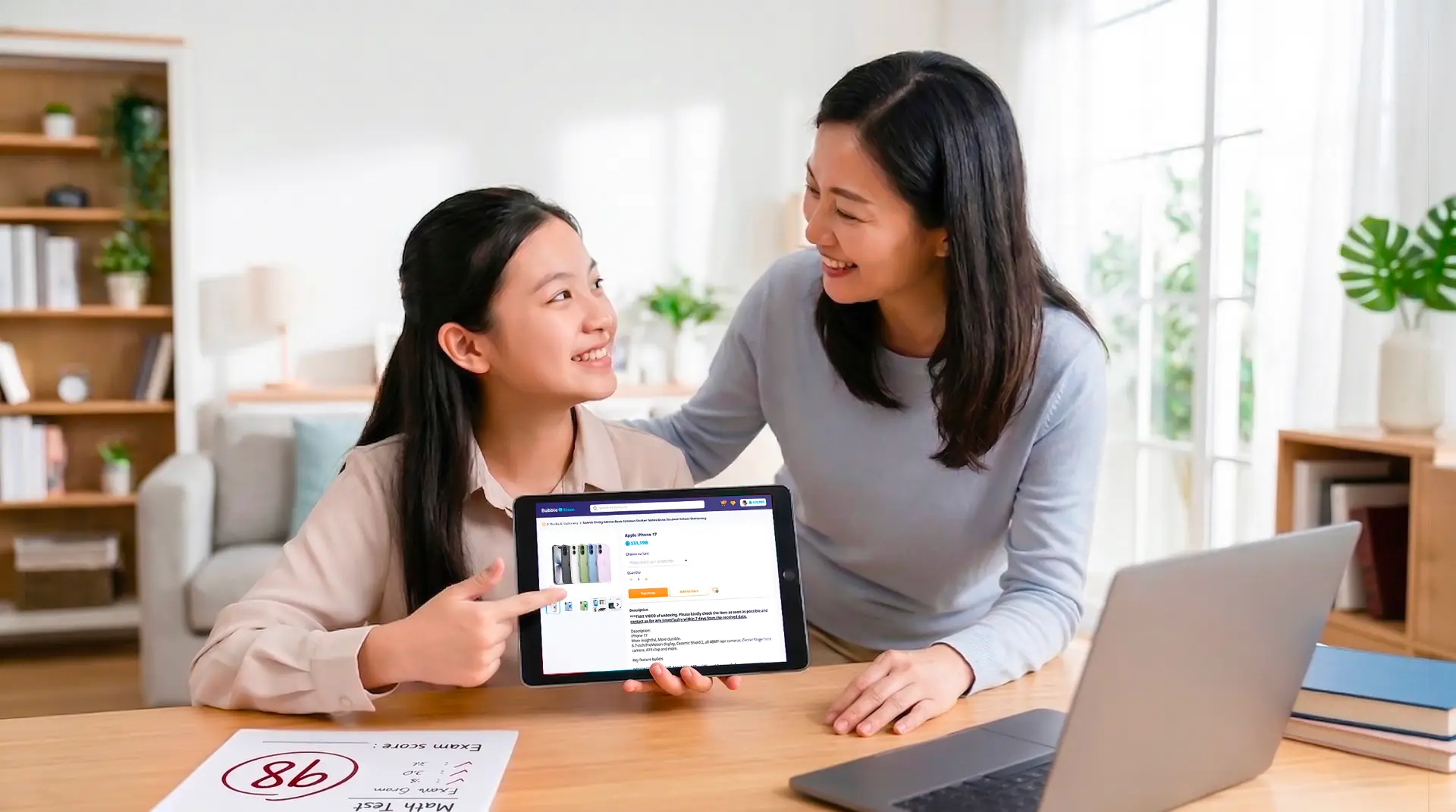
Local platforms have effectively implemented these systems. For instance, as The Straits Times noted in December 2022, Koobits allows students to earn 'Koobits points' to spend in a virtual world, while Geniebook integrates points and badges to motivate learners and taking the game to the next level allowing students to redeem popular rewards such as Roblox, Pokemon Trading Cards, Nintendo Switch 2 and even iPhone 17. These platforms appeal to different student personalities. Some are 'collectors' who love acquiring virtual goods, while others are 'achievement hunters' driven by topping the leaderboard, a concept explored in a 2023 study by MDPI on gamification.
The Real Benefits for Students Beyond Just 'Fun'
While the immediate appeal is engagement, the advantages of a well-designed incentive system run deeper. Firstly, digital platforms offer unwavering consistency. Unlike a busy parent or tutor who might forget to praise every small effort, an automated system logs and rewards every single completed task. This consistency is crucial for building habits.
Secondly, the convenience of online tuition for students saves significant travel time. That reclaimed hour can mean more time for rest, CCAs or family, reducing learning fatigue and making study feel less like a chore. As interest in remote learning remains high post-pandemic, many parents appreciate this practical benefit. Students also gain the ability to re-watch recorded lessons to master difficult concepts at their own pace.
Finally, interacting with these platforms inherently improves a child's digital literacy. Navigating dashboards, tracking progress and managing rewards are all small actions that build familiarity with the digital tools essential for their future education and careers.
The Big Question: Do Rewards Kill the Love for Learning?
This is a valid and important concern for many parents. Will my child only study for the points and not because they are genuinely interested? The distinction here is between extrinsic motivation (external rewards) and intrinsic motivation (the internal drive to learn). Research has shown that an over-reliance on external rewards can potentially 'erode intrinsic motivation'. A 2017 study published in ScienceDirect found that high extrinsic incentives could weaken the effect of a person's inner drive.
However, it’s not a simple case of one cancelling out the other. The most effective approach is to view digital incentives as a kick-starter, not the final destination. For a student who is disengaged or finds a subject difficult, the promise of a reward can be the push they need to get started. Once they begin practising and start seeing their own improvement, getting better scores and understanding concepts that once confused them, a sense of mastery begins to grow. This feeling of competence is a powerful driver of intrinsic motivation.
The key is balance. The goal is to use the external reward to build a routine and then let the confidence from academic success take over as the primary motivator.
A Parent's Guide: What to Look for in a Gamified Platform
Not all incentive systems are created equal. When evaluating an online learning platform, consider the following:
- Academic Alignment: The core of the platform must be its educational value. Are the worksheets, lessons and content rigorously aligned with the latest MOE syllabus? The rewards are meaningless if the academic foundation is weak.
- Fair Reward Structure: An effective system should reward effort and progress for all students, not just the top performers. Research on crowdsourcing incentives shows that 'winner-take-all' models fail to motivate the majority. Look for systems that celebrate personal milestones and consistent work.
- Balanced Engagement: The platform should encourage focused learning, not just endless clicking to earn points. Are there clear learning objectives or can a child get lost in the game-like elements without actually studying?
Conclusion
Digital incentives are a powerful tool in a parent's arsenal for tackling the motivation problem. They leverage psychology to make the often-demanding process of learning more engaging and consistent. However, they are not a substitute for a strong academic curriculum or parental involvement. Think of the points and bubbles as the scaffolding that helps your child build a strong structure of study habits. Once that structure is in place, the intrinsic motivation born from genuine academic achievement and confidence can become the foundation that supports them all the way to their A's.