


GCE O-Level 2026 Scoring System
The Ultimate Guide to O-Level Scoring System and Post-Secondary Admissions in Singapore
Receiving GCE O level results marks a pivotal milestone for every Singaporean student. It culminates years of hard work and requires young learners to make significant decisions about their future career paths.
Parents naturally experience both pride and anxiety during this period. Will your child qualify for their dream course? Should you choose a Junior College or a Polytechnic? How do you calculate aggregate scores correctly?
Understanding the O level scoring system empowers you to make an informed choice.
Singapore offers diverse educational pathways. These range from the academic rigour of Junior colleges to the applied learning environments of Polytechnics in Singapore and the technical expertise of the ITE.
This guide comprehensively breaks down current admission criteria and upcoming shifts in the education landscape.
O level Scoring system
Navigating the GCE O level scoring system requires understanding one key rule: in Singapore, a lower score is better. The system assigns each subject a grade from A1 to F9 based on your child's performance.
The Singapore Examinations and Assessment Board (SEAB) uses a standards-referenced system instead of a bell curve. They do not publish fixed mark boundaries for each grade. However, we rely on common school practices and tuition benchmarks to provide these widely recognised guide ranges to help you understand the O level grading system.
| O level grade | Commonly cited mark range | Pass/Fail status |
| A1 | 75% and above | Pass |
| A2 | 70% – 74% | Pass |
| B3 | 65% – 69% | Pass |
| B4 | 60% – 64% | Pass |
| C5 | 55% – 59% | Pass |
| C6 | 50% – 54% | Pass |
| D7 | 45% – 49% | Fail (for most progression) |
| E8 | 40% – 44% | Fail |
| F9 | Below 40% | Fail |
O level grading reflects mastery against an absolute standard. SEAB does not "force fit" scores into pre-determined proportions. In 2025, 86.9% of candidates achieved at least five passes, reflecting high literacy and numeracy standards across the cohort.
When calculating your child's aggregate, an A1 contributes 1 point and a C6 contributes 6 points. Students aim for the lowest possible total to meet the competitive JC cutoff or polytechnic entry requirements.
Junior College (JC) admission criteria
Does your child plan to attend a Junior College? Their admission depends heavily on their L1R5 scores.
The Ministry of Education uses the L1R5 O level aggregate during the Joint Admissions Exercise (JAE) to determine eligibility for this two-year pre-university route.
What is the L1R5 system?
The L1R5 comprises:
-
L1: 1 Language Subject (English or Higher Mother Tongue)
-
R5: 5 other Relevant Subjects
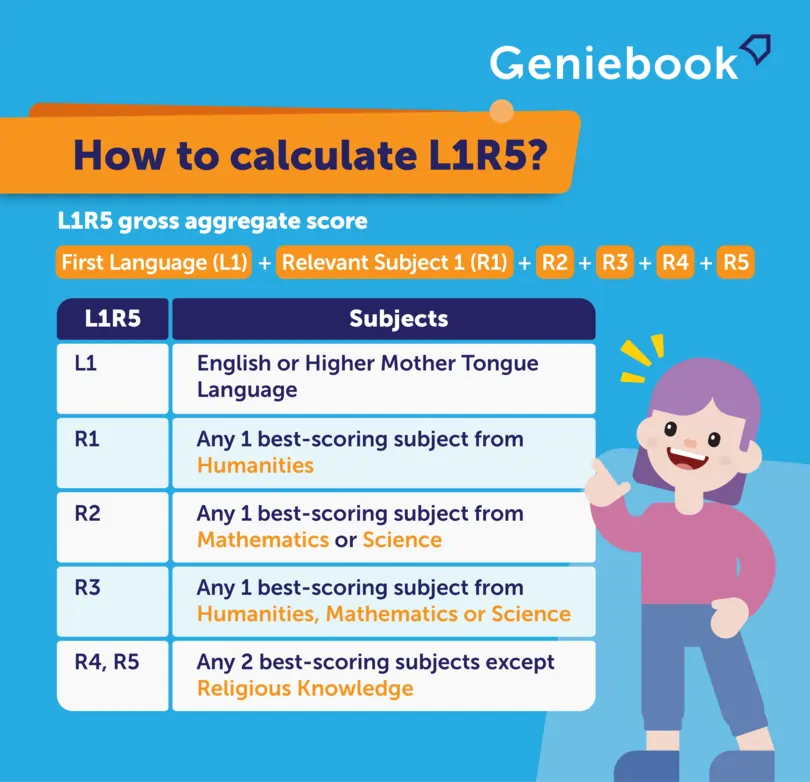
Students must choose their L1R5 subjects carefully. The five relevant subjects must include at least one Mathematics or Science subject, alongside one Humanities subject.
This requirement ensures your child builds a balanced academic foundation before they specialise in the JC Arts or Science streams.
Strict grade requirements govern JC admission. Your child’s gross L1R5 score must not exceed 20 points. They must also achieve at least a C6 in English, a C6 in Mother Tongue (or a pass in MT 'B') and a D7 in Mathematics.
|
Subject |
Grade |
|
English |
1-6 |
|
E. Maths / A. Maths |
1-7 |
|
Any 1 Mother Tongue Language (MTL)
|
|
Bonus Points and Cutoffs
The JC cutoff for Singapore's top schools remains incredibly competitive. Raffles institution JC, for example, often demands a net L1R5 range of 2 to 5 points.
To hit these tough targets, students rely on bonus points. Your child can deduct up to 4 points from their gross score through:
-
CCA Excellence: 2 points for an A1/A2 grade or 1 point for B3-C6.
-
Higher Mother Tongue: 2 points for achieving at least a C6.
|
Requirement |
Maximum no. of points deducted |
|
CCA grade of A1 or A2 |
2 points |
CCA grade of B3 to C6 |
1 point |
|
At least a C6 grade for Higher Mother Tongue |
2 points |
|
An A1 to C6 grade for Chinese or Malay Special Programmes |
2 points |
Example: Imagine John earns an A1 grade for his CCA and scores a B4 for his Higher Mother Tongue. He meets both criteria and successfully deducts 4 points. If his raw L1R5 is 15, his final net score drops to an impressive 11.
Millennia Institute (MI) admission criteria
Millennia institute offers a three-year programme for students who prefer a paced approach to the A-Level curriculum. This unique pathway provides the exact same terminal qualification as a JC. It gives students more time to mature and master their subjects.
Admission to Millennia institute depends on the L1R4 aggregate score rather than L1R5. The calculation incorporates one language subject and four relevant subjects. Students need a gross L1R4 score of 20 points or lower to qualify.
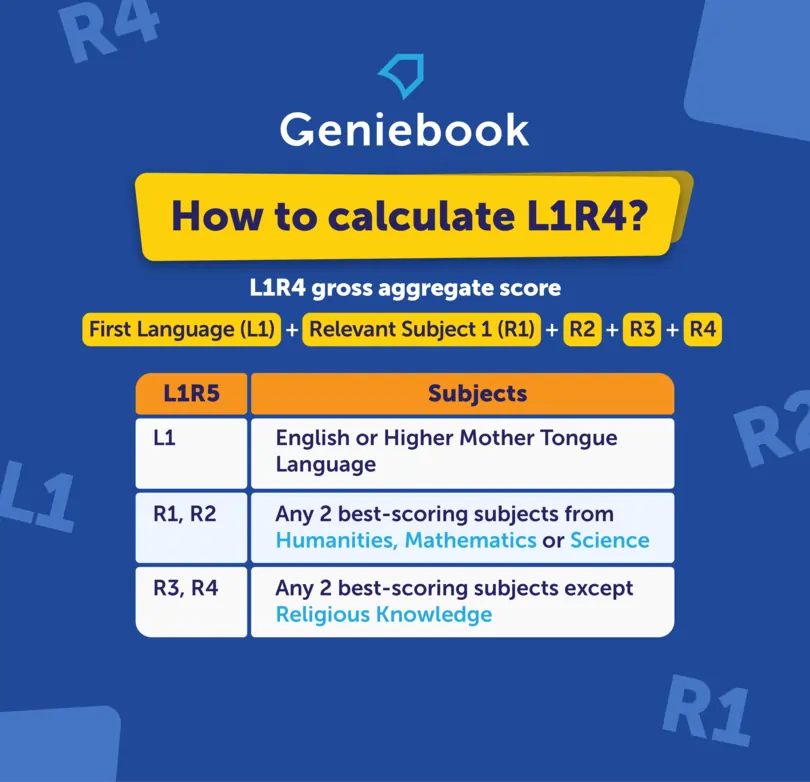
Understanding L1R4 for MI
L1R4 criteria share the same subject exclusions as the JC system. For example, you cannot use both Higher Mother Tongue and Mother Tongue of the same language in your aggregate score. If you use Higher Chinese as your L1, you cannot use Chinese as an R4 subject.
MI organises Millennia institute courses into Business, Commerce and Arts/Science streams. This route perfectly suits students who:
-
Want an A-Level certificate but find the two-year JC pace too intense.
-
Show a strong, early interest in business-related subjects.
-
Thrive in an environment focused on consistent progress across three years.
MI uses the exact same bonus point system as JCs. You can deduct a maximum of 4 points for CCA and Higher Mother Tongue. These bonus points often help students cross the 20-point entry threshold.
Polytechnic admission criteria
Polytechnics in Singapore offer an increasingly popular educational pathway. Today, nearly half of O-Level graduates who qualify for Junior College choose the polytechnic route instead. Polytechnic admission requires the ELR2B2 score, not L1R5.
What is the ELR2B2 system?
The ELR2B2 system stands for:
-
EL: English Language
-
R2: 2 Relevant Subjects (determined by the specific diploma group)
-
B2: 2 other Best Scoring subjects
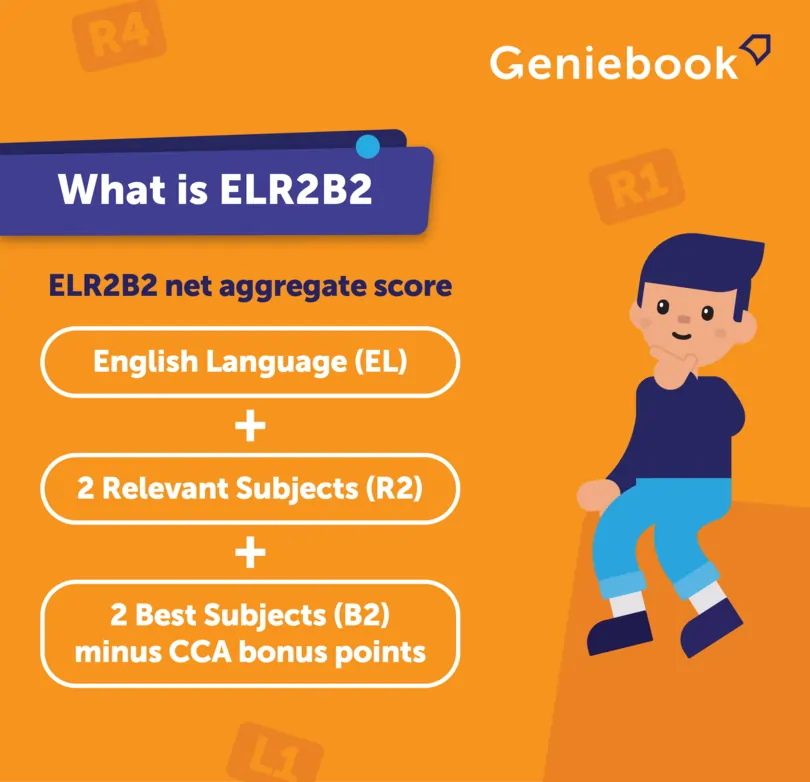
Students must achieve a net ELR2B2 score of 26 points or lower to qualify for most polytechnic courses. The Diploma in Nursing provides a notable exception, accepting scores up to 28.
Many parents and students mistakenly calculate L1R4 for poly. While certain ITE-to-poly pathways use similar counts, the O-Level Joint Admissions Exercise (JAE) strictly applies the ELR2B2 aggregate.
Choosing the Right Poly
When evaluating Ngee Ann poly Singapore or Singapore poly, parents must look beyond cut-off scores. Each institution champions its own niche. Ngee Ann poly Singapore excels in business and mass communication courses. Singapore Temasek Polytechnic frequently stands out as the top choice for design and applied sciences. NYP (Nanyang Polytechnic) and Singapore Polytechnic also provide a vast array of engineering and IT diplomas.
The polytechnic EAE (Early Admissions Exercise) offers a game-changing opportunity for students with clear passions. This pathway allows students to secure a place based on their portfolio and interests before exams begin. Students must still achieve the minimum ELR2B2 score of 26 to confirm their spot.
Furthermore, ITE graduates can progress via JPAE (Joint Polytechnic Admissions Exercise), which evaluates their GPA as the primary admission criteria.
Institute of Technical Education (ITE)
Singapore's ITE stands as a world-class institution for technical and vocational training. Leaving behind its past reputation as a "last resort", it now provides a highly practical and viable pathway for students who thrive in hands-on, industry-relevant environments.
ITE admission for O-Level holders typically involves applying for Higher Nitec courses. To qualify, students must sit for at least five O-Level subjects over a maximum of two years. Unlike Junior Colleges or Polytechnics, ITE evaluates course-specific Minimum Entry Requirements (MERs) rather than a single universal aggregate.
The Shift to 3-Year Higher Nitec
The traditional distinction between Nitec and Higher nitec is evolving. By 2026, ITE will fully transition to an enhanced three-year curriculum leading directly to a Higher Nitec qualification. This new structure streamlines the educational journey, enabling students to gain deeper mastery without re-applying between levels.
-
Nitec: Previously served as the baseline for technical skills.
-
Higher nitec: An advanced qualification that often grants students polytechnic exemptions.
Under this updated system, O-Level and Normal Academic students often join the three-year Higher nitec programme directly in the second year, allowing them to graduate in just two years. Students frequently choose popular courses like AI Applications, Cyber & Network Security and Data Engineering. These robust ITE requirements prepare students thoroughly for the high-tech demands of the modern workforce. Upon entering the labour force, many ITE graduates earn a decent median salary.
PSE: A new change in admission exercise in 2028
In 2028, the Singapore education landscape will undergo a major transformation as schools fully implement Full subject based banding (FSBB). This milestone ends the traditional "Express" and "Normal" streams. Instead, students will benefit from a flexible system, taking subjects at different levels (G1, G2 or G3).
The introduction of the Singapore-Cambridge Secondary Education Certificate (SEC) directly updates the Post-Secondary Admissions Exercise (PSE). Crucially, future JC applicants will transition from a 6-subject aggregate (L1R5) to a 5-subject aggregate.
What to expect in 2028:
-
L1R4 for JC: To reduce your child's examination load, schools will calculate JC admission scores using L1 and their 4 best relevant G3 subjects, not exceeding 16 points.
-
L1R4 for MI: Similarly, schools will calculate MI admission scores using L1 and their 4 best relevant G3 subjects, not exceeding 20 points.
-
Bonus Point Cap: As students take fewer total subjects, the maximum bonus point deduction for JC admission will likely drop from 4 to 3 points.
-
Polytechnic Entry: Students need to achieve an ELR2B2 net score that does not exceed 22 points. ELR2B2 net score for Nursing must not exceed 24.
-
ITE Entry: For the 2028 intake, students taking G2 and G3 subjects can apply for direct entry into the second year of Higher Nitec. They simply need to achieve an ELMAB3 score of 19 or better.
These changes under FSBB actively recognise your child's diverse strengths. Rather than keeping students confined to a single stream, the new system empowers your child to pursue strong subjects at a higher level (G3) while pacing others more manageably (G2).
Ultimately, this custom-made education journey reduces stress and fosters a lifelong love for learning.
Conclusion
Navigating the O-Level journey requires both strategy and hard work. Your child might aim for top junior colleges, explore a specialised diploma at Singapore Temasek Polytechnic or pursue a hands-on career through ITE. Understanding these rules ensures they stay ahead on results day.
At Geniebook, we believe every student excels with the right support. Our AI-personalised revision plans target specific weaknesses, helping students bridge the gap between a B4 and an A1 alongside with many other useful AI powered learning features.
We offer over 300,000 MOE-aligned questions to help your child master the O level with absolute confidence.
FAQs
1. Can I use Higher Mother Tongue to replace English as my L1?
You can use Higher Mother Tongue (HMT) as your First Language (L1) in the L1R5 O level computation for JC admission.
However, using HMT as your L1 means you cannot use the standard Mother Tongue subject as an R5 relevant subject. This rule prevents double-counting the same language discipline in your aggregate.
2. Is the polytechnic EAE offer guaranteed?
A polytechnic EAE offer remains conditional. It secures your spot based on your aptitude and portfolio, but you must still meet the academic floor.
O-Level students must achieve a net ELR2B2 score of 26 or better and meet the specific minimum entry requirements (MERs) for their chosen diploma.
3. What is the difference between gross and net aggregate scores?
Your gross score represents the raw total of your subject grades (e.g., A1=1, B3=3).
Your net score represents the final figure after deducting bonus points for CCA excellence or Higher Mother Tongue. Always refer to the net score when checking the JC cutoff or polytechnic entry scores, as this determines your final posting.
4. How does the JPAE poly process work for ITE students?
The Joint Polytechnic Admissions Exercise (JPAE) caters to ITE graduates until 2027.
Polytechnics base admission primarily on your Grade Point Average (GPA) from your Higher Nitec or Nitec course. Highly relevant ITE courses may qualify you for module exemptions, shortening your polytechnic journey.
5. Can I apply to both JC and Poly during the JAE?
Yes, you can. In 2027, you may list up to 12 choices in order of preference during the Joint Admissions Exercise. In 2028, a different admission system (PSE) will be implemented.
These choices can mix Junior Colleges, Polytechnics and the Millennia Institute. The system posts you to your highest-ranked choice where you meet the aggregate and secure a vacancy.