


GCE O-Level 2026 Timetable

GCE O-Level Timetable: The Ultimate Guide to Exam Dates, Results and Registration
For Singaporean families, the GCE O-Level examination marks a vital educational milestone. Intense revision, late nights and parental worry often define this critical period. However, creating a smoother O-Level experience requires more than just completing assessment books, you must master the GCE O-Level timetable.
The O-Levels operate as a six-month marathon, not a single-month sprint. Understanding this extended timeline significantly reduces household stress.
Examinations stretch from the early Mother Tongue papers in June to the final Science MCQ papers in November. Anticipating these key milestones helps parents effectively plan family rest, tuition schedules and emotional support.
Looking ahead to the 2026 calendar, this guide synthesises official data from the Singapore Examinations and Assessment Board (SEAB) and the Ministry of Education (MOE). Use this comprehensive breakdown to navigate the crucial exam year with confidence.
GCE O-Level Timetable Overview
The official O-level timetable is a complex, multi-phase schedule published annually by SEAB. Before the main October exams begin, students can complete up to 30% of their total assessment.
The SEAB O-level timetable categorises exams into four distinct modes. First, Oral Examinations for languages test fluency and interaction using video-based stimuli.
Next, SEAB conducts Listening Comprehension (LC) papers simultaneously for thousands of candidates in a single afternoon. Science Practical Examinations follow in late September, requiring students to demonstrate hands-on lab skills in Physics, Chemistry and Biology.
Finally, Written Papers form the bulk of the theory assessment in October and November.
Parents and students must also monitor a key logistical detail: the "Entry Proof". SEAB issues this personalised document to every candidate.
While SEAB standardises written paper timings, they assign Science Practical shifts and Oral exam slots to each individual.
For practicals, venues can change. Students often receive their exact reporting time just seven days before the experiment. Therefore, you should treat the O-level exam timetable as a living document that requires close attention throughout the year.
O-Level Exam Dates and Exam Period
Parents often ask us, "When is O-level?". The answer depends entirely on your child's specific subject combination. The O-level exam schedule for 2026 follows a structured pattern. It assesses language proficiency early in the year and tests core content mastery towards the year-end.
Based on the SEAB O-level timetable for 2026, expect this assessment window:
- Early June: Mid-Year Mother Tongue written papers.
- July to August: English and Mother Tongue Oral examinations.
- Late September to Mid-October: Music and Science Practical exams.
- Late October to Mid-November: Intensive written paper phase.
For core subjects, the 2026 written exams start on 19 October 2026 with English Language Paper 1 and 2. Mathematics (E. Math) follows closely between 21 and 23 October. SEAB clusters Humanities and Pure Science theory papers in late October. Finally, the "Science MCQ" papers conclude the examinations in the second week of November.
This tight scheduling creates a "Hell Week" for students. During this 72-hour window, English, Mathematics and a Science paper often overlap. We recommend mapping these O-levels exam dates early. Anticipating these high-pressure peaks helps you provide your child with essential rest and proper nutrition.
When Does O-Level Start and End
The O-level exam season begins long before the year-end months. For the 2026 cohort, the journey starts on Tuesday, 2 June 2026, with the Mother Tongue (Chinese, Malay and Tamil) written papers. This early milestone gives students valuable exposure to the national exam atmosphere before the June holidays commence.
The main season for the O-Levels begins with the Science Practicals in late September. For most students, the final exams conclude between 10 and 12 November 2026. For instance, the 2026 calendar schedules Biology and Combined Science Paper 1 as final papers on 10 November.
| Phase | Start Date (2026 Tentative) | End Date (Tentative) |
| Mother Tongue Mid-Year | 2 June 2026 | 2 June 2026 |
| Oral Examinations | 13 July 2026 | 4 August 2026 |
| Sciece Practicals | 30 September 2026 | 13 October 2026 |
| Main Written Papers | 19 October 2026 | 10 November 2026 |
Knowing when the O-level exam ends helps you plan post-exam celebrations. Unlike the PSLE, O-Levels have no designated "marking days". Scripts, excluding Mother Tongue subjects, travel directly to Cambridge for marking. Consequently, your child's school term continues exactly as planned on the MOE calendar until they sit their final paper.
O-Level Oral Examination Dates
O-level oral dates often trigger the first wave of real exam nerves. Schools usually conduct these high-stakes exams in July alongside regular lessons. In 2026, the English Language Oral exams will run across mid-July (such as 13–17 July), featuring both morning and afternoon sessions.
The examination format has evolved significantly. Students now engage with a video stimulus instead of simply reading a passage. They must interpret visual cues and sustain a conversation with two examiners. GCE O-level English oral components directly test your child's vocabulary and their ability to think quickly on their feet.
Mother Tongue oral exams run concurrently or immediately after the English window. For O-level Chinese, Malay and Tamil, the oral component provides a vital opportunity to secure a "Distinction" or "Merit" grade in the oral/aural category.
Students take turns during examinations, meaning your child might spend several hours waiting in a holding room. Preparing your child for this wait helps keep their mind calm and focused. This mental preparation proves just as important as their actual speaking practice.

O-Level Chinese and Mother Tongue Exam Timeline
The O-level Chinese and Mother Tongue timeline offers a unique "two-chance" system. Singaporean students sit the written papers (Paper 1 and 2) in June. MOE and SEAB strategically schedule this to let students focus purely on languages before tackling heavy content subjects in October.
The mother tongue O-level results release date for this mid-year sitting typically falls in mid-August, shortly after National Day. Students then face a clear choice. If they achieve an A1 or feel satisfied with their grade, they can "park" the subject to focus on their other five or six subjects. Students wanting to improve can retake the written papers during the year-end Gce O-level Singapore window in November.
For the year-end retake, students only resit the written papers. Their Oral and Listening Comprehension scores from July automatically carry forward. The final certificate will reflect the better of the two written grades. Roughly 20–30% of students choose to retake, but families should weigh this decision carefully. Retaking Chinese in November adds another paper to study for during an already packed O-level exam schedule.
O-Level Registration Timeline
Registration for the O-Levels occurs much earlier than the exams. For school candidates, the secondary school administration handles this seamless process, usually in March of the examination year. Students simply verify their personal details and subject combinations.
Private candidates must take more initiative. GCE O-level registration for private candidates typically opens in early April. For 2026, the registration window runs from 7 to 20 April. Candidates complete this via the SEAB Candidates Portal using Singpass.
Private candidates must be at least 15 years old as of 1 January of the exam year. Registering during the official window is crucial, as late registration incurs a $75 late fee. Private candidates also pay significantly higher per-subject fees compared to the subsidised rates school candidates enjoy. Once registered, private candidates must regularly check the portal for their "Entry Proof" and specific Science Practical instructions, as they lack a school teacher to remind them.
O-Level Results Day and Results Release
"When do O-level results come out?" is a question that keeps many 16-year-olds awake in January. Traditionally, O-level results day falls in the second week of January following the exams. For the 2025 cohort, the O-level results release date was 14 January 2026.
On this day, school candidates return to their secondary schools at 2:00 PM to collect their physical result slips. It represents a major emotional milestone. Teachers deliver final speeches and Education and Career Guidance (ECG) counsellors stand ready to guide students. Private candidates access their results online via the SEAB portal from 2:45 PM on the same day.
Alongside the result slip, students receive Form A. This crucial document lists their aggregate scores (L1R5 or L1R4) and the specific courses they are eligible for across Junior Colleges, Polytechnics and ITEs. Form A triggers the Joint Admissions Exercise (JAE), which opens just three to five days after the results release. Deciding on a post-secondary pathway demands quick action, so we strongly encourage students to research polytechnic courses and JC subject combinations well before results day.
Role of SEAB and MOE in the O-Level Schedule
The GCE O-Level represents a strong collaboration between three main bodies: MOE, SEAB and Cambridge International Education.
SEAB acts as the "architect" of the O-level schedule. They develop the examination timetable, manage exam paper security and oversee private candidate registration. They provide the official PDF of the timetable. Meanwhile, MOE acts as the "administrator". They set the national curriculum, determine the school terms and manage the JAE system after results are released.
Cambridge provides essential international benchmarking and expertise. They mark most written scripts for non-language subjects. This partnership ensures the Gce O-level Singapore certificate remains a global "gold standard", highly recognised by universities and employers worldwide. Interestingly, MOE and SEAB solely set and mark the Mother Tongue papers. This local control ensures our language syllabi remain culturally relevant to Singapore’s unique bilingual context.
Differences Between O-Level, A-Level and N-Level Timetables
We understand that managing multiple national exam dates often confuses parents with children across different levels. Although all these exams fall under the SEAB umbrella, each follows a distinct rhythm.
The N-Level timetable for Normal Academic and Normal Technical students concludes first. Students sit for their main written papers in September and receive their results in mid-December. This early timeline allows N(A) students to decide whether they will progress to Secondary 5 to take the O-Levels the following year.
Conversely, the A-Level timetable runs the longest and finishes last. While O-Level dates conclude in mid-November, JC students often sit for their H2 papers until late November or early December. Consequently, schools release A-Level results much later, typically in late February or early March.
| Feature | N-Level | O-Level | A-Level |
| Main Written Month | September | Oct - Nov | Nov - Dec |
| Results Release | Mid-December | Mid-January | Late February |
| Next Step | Sec 5 / ITE / PFP | JC / Poly / ITE | University |
Looking ahead, the Singapore-Cambridge Secondary Education Certificate (SEC) will replace the O-Level and N-Level labels from 2027 as part of the shift towards Full Subject-Based Banding (Full SBB). Until then, the O-Level remains the definitive graduation exam for the Express and Sec 5 streams.
Conclusion
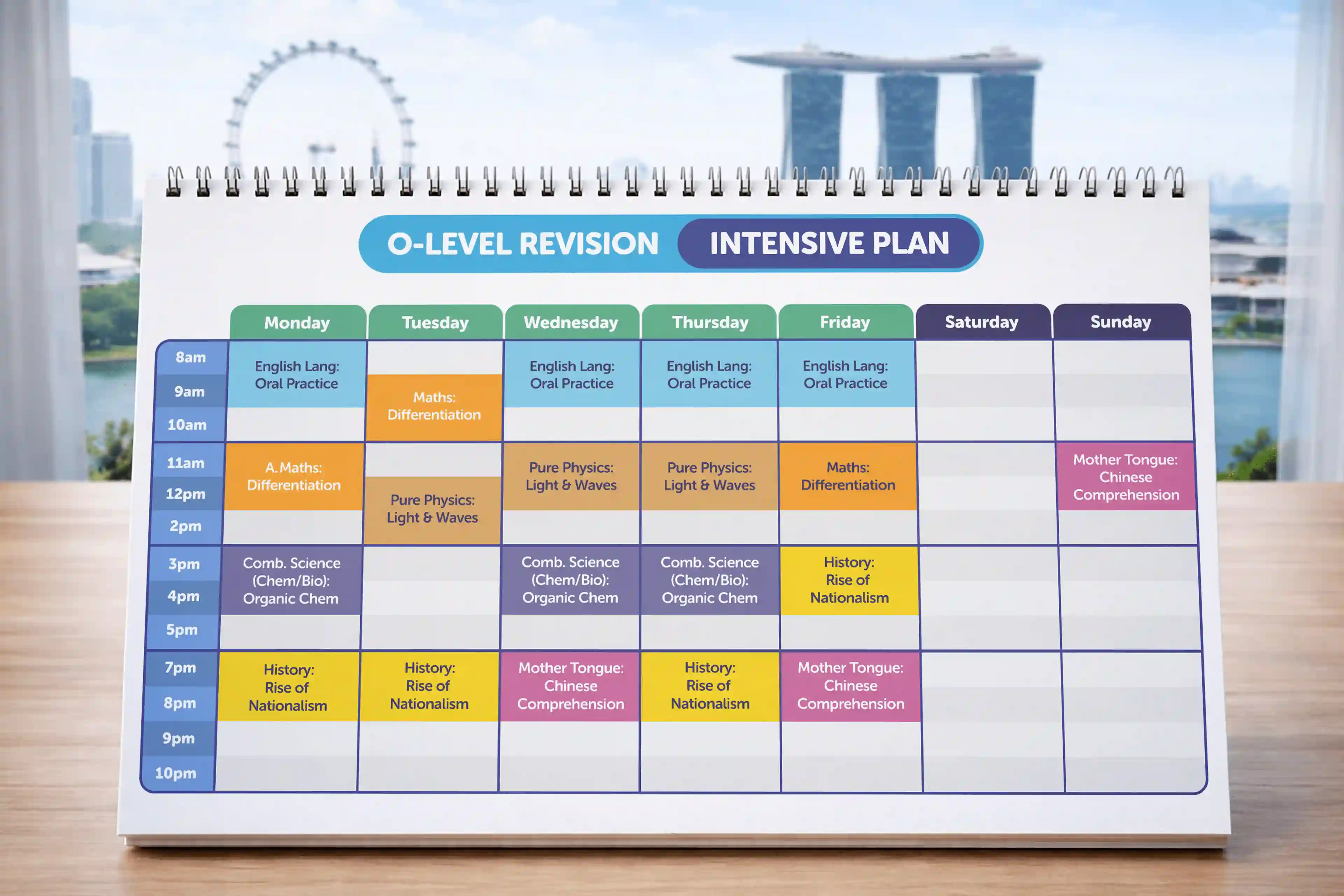
The GCE O-Level Timetable provides a crucial roadmap for a Singaporean student's academic journey.
Understanding the staggered nature of the exams, from the June Mother Tongue papers to the January results release, empowers you to guide your child. You can effectively help them pace their studies and prevent burnout before the final papers.
While exam dates remain fixed, your preparation strategy offers flexibility. Success in the O-Levels demands consistent revision, physical well-being and emotional resilience.
As the exam season approaches, remember you do not have to navigate this journey alone.
FAQs
When is the GCE O-Level examination held in Singapore?
The O-Level examination is a multi-month journey. It officially kicks off with the Mother Tongue written papers in early June.
Students take their oral exams in July and August. Next, they complete their Science Practicals from late September to early October.
Finally, students sit for the main written papers in core subjects like English, Mathematics and Humanities between mid-October and early November.
Where can I find the official SEAB O-Level timetable?
You will find the most reliable information on the official SEAB website. SEAB typically releases the tentative year-end timetable in February or March of the examination year.
You can also access the "Examination Calendar" directly through the MOE National Examination Dates page. Always double-check that you are viewing the PDF for the correct examination year.
When will O-Level Chinese results be released?
SEAB typically releases the mid-year Mother Tongue (Chinese, Malay, Tamil) written exam results in mid-August.
This early release gives students a helpful advantage. If your child wants to improve their grade, they can register to retake the paper during the November written examination window. The final January certificate will officially reflect your child's best score.
What happens if my child is sick on an O-Level exam date?
Health always comes first. Students should never attempt an exam if they are severely unwell.
If your child misses a paper due to illness, simply provide a valid Medical Certificate (MC). Your school will actively assist you in applying for "Special Consideration" through SEAB.
To ensure fairness, SEAB calculates a projected grade using your child's preliminary exam results alongside the overall cohort performance.
How do private candidates get their O-Level entry proof?
SEAB does not send physical entry proofs to private candidates by post.
Instead, candidates must log in to the SEAB Candidates Portal using their Singpass or registered account details.
Candidates can easily download the entry proof a few months before the written examinations begin. This essential document contains the complete exam schedule and venue details.