


PSLE 2026 Scoring System
Understanding the PSLE Scoring System and AL Scores
Achievement Levels (AL 1 to AL 8) have replaced the old T-score system. Each subject gives your child an AL grade and the sum of the AL grades for all subjects forms their PSLE Score. This score determines secondary school posting based on cut-off points and choice order.
Navigating the PSLE for the first time is daunting. We understand. You want to know how posting decisions happen, how cut-off points work and how AL bands operate. Let’s break down the Singapore PSLE scoring system so you can plan your child’s next move with confidence.
What Is PSLE?
The Primary School Leaving Examination (PSLE) serves as the national benchmark for primary 6 students studying in Singapore. It evaluates pupils' mastery of the elementary school curriculum and helps them be placed in a secondary school that suits their rate of learning.
It backs the Ministry of Education's transition to holistic assessment, which goes beyond academic evaluation. Instead of competition, the emphasis switches to comprehension, advancement, and suitable routes.
What Is the PSLE Scoring System?
The PSLE scoring system measures a student’s achievement using Achievement Levels (ALs) instead of ranking students by relative performance.
Each subject is graded using fixed score bands, from AL 1 (highest achievement) to AL 8. A student’s final PSLE score is calculated by adding the AL scores from four subjects:
- English
- Mathematics
- Science
- Mother Tongue
The total PSLE score ranges from 4 to 32, where a lower score reflects stronger academic performance.
Why Was the PSLE Scoring System Changed?
The new PSLE scoring system, introduced in 2021, replaced the old T-score model to reduce excessive competition and fine score differentiation.
Key differences between the old and new PSLE scoring systems
|
Old PSLE Scoring System |
New PSLE AL Scoring System |
|
Relative ranking using T-scores |
Absolute achievement levels |
|
Small score differences mattered greatly |
Wider score bands |
|
High academic pressure |
Focus on mastery and progress |
|
Aggregate score up to 300+ |
Total AL score from 4 to 32 |
This change ensures students are assessed based on what they know and can do, not how they compare with others.
How Will the Current PSLE Scoring System Benefit Your Child?
The current PSLE scoring system supports healthier learning outcomes by:
- Reducing stress from marginal mark differences
- Encouraging consistent understanding instead of last-minute cramming
- Supporting fairer secondary school posting decisions
- Allowing students to learn at a pace suited to their readiness
For parents, this brings clearer expectations and more meaningful conversations about progress and improvement.
What Is the AL Scoring System?
The AL scoring system uses eight Achievement Levels to reflect a student’s standard of mastery for each subject.
- AL 1 reflects very strong mastery
- AL 8 reflects minimal grasp of subject content
Each subject’s AL score is added together to form the final PSLE score.
Achievement Levels (AL) and Corresponding Score Ranges
Under the PSLE AL scoring system, each subject is graded using fixed score ranges, ensuring transparency and consistency.
Standard subjects (English, Mathematics, Science, Mother Tongue)
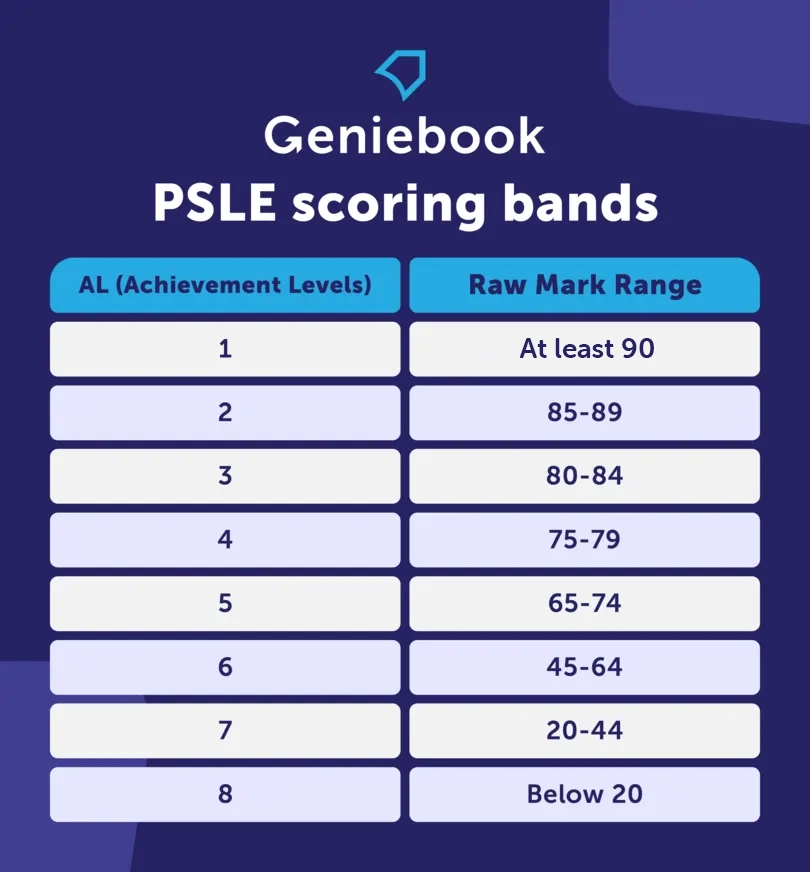
A lower AL number indicates stronger performance. The sum of the four AL scores gives a total PSLE score ranging from 4 to 32.
AL Score Range for Foundation Subjects
Foundation subjects support students who need a more gradual learning pace, while ensuring they can still progress smoothly to secondary school.
Instead of eight Achievement Levels, Foundation subjects use three AL bands, which are mapped to the main AL scale for PSLE scoring.
Foundation subject AL banding
|
Foundation Achievement Level |
Raw Mark Range |
AL used in PSLE score |
|
Foundation AL A |
75 – 100 |
AL 6 |
|
Foundation AL B |
30 – 74 |
AL 7 |
|
Foundation AL C |
Below 30 |
AL 8 |
What parents should know
- Foundation subjects contribute to the overall PSLE score
- The mapped AL values ensure fair secondary school posting
- Students are supported based on readiness rather than penalising them
This structure aligns with MOE’s focus on Subject-Based Banding (SBB) and appropriate academic pacing.
How Is the PSLE Score Calculated?
Calculating the final score is straightforward. You determine the AL score for each subject and add them together.
Example
- English: AL 1
- Mathematics: AL 3
- Science: AL 6
- Mother Tongue: AL 6
Total PSLE score = 1 + 3 + 6 + 6 = 16
This replaces the old PSLE aggregate system and makes the calculation straightforward and transparent.
Curious about your child's potential score? Key in their expected grades into our PSLE Score Calculator!
PSLE T-Score vs AL Score
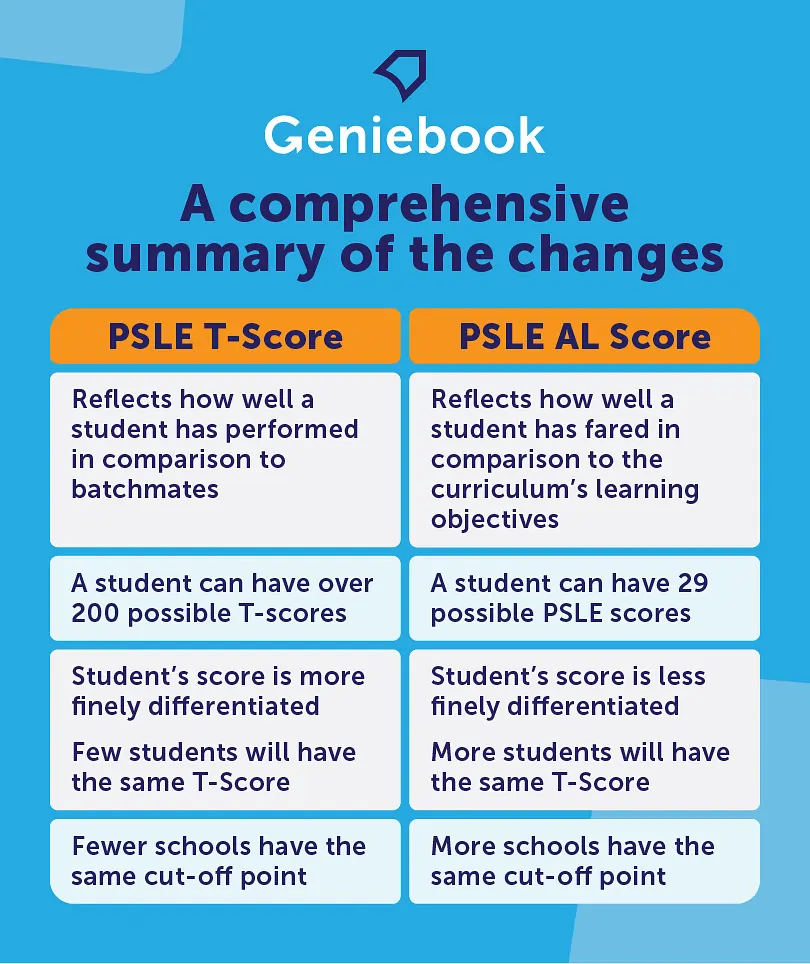
The main difference between the old and new PSLE scoring systems is that the old T-Score system focused on exact marks, while the new AL system groups the student's marks into broader levels. This reduces pressure on students to stop aiming for specific high scores and helps them focus on their own learning and growth.
Let’s Look at an Example
Imagine Tim scored 270 and Jim scored 275. Under the T-score system, that gap mattered immensely. Under the new AL system, both achieve a score of 4. Their chances of getting into their choice school become equal.
With more schools having the same cut-off point, students have wider choices. You can look beyond just academics. Consider strengths, interests, school culture and co-curricular activities for the next stage of education.
What Is a Good PSLE Score?
Defining a ‘good’ score is stressful. You naturally aim for top schools but the new AL system moves beyond simple labels.
We believe a good score gets your child into a school that fits their learning style. Compatibility is key. Every score band maps to a Posting Group tailored to help students succeed at their own pace.
- Lower PSLE Scores: These open the widest variety of secondary school options.
- Mid-Range Scores: These unlock strong pathways through Posting Groups G2 and G3.
- Higher PSLE Scores: These access well-supported environments suited to a measured learning pace.
No single number is ideal. What matters is placing your child in an environment where they can grow with confidence.
PSLE Scores and Secondary School Posting
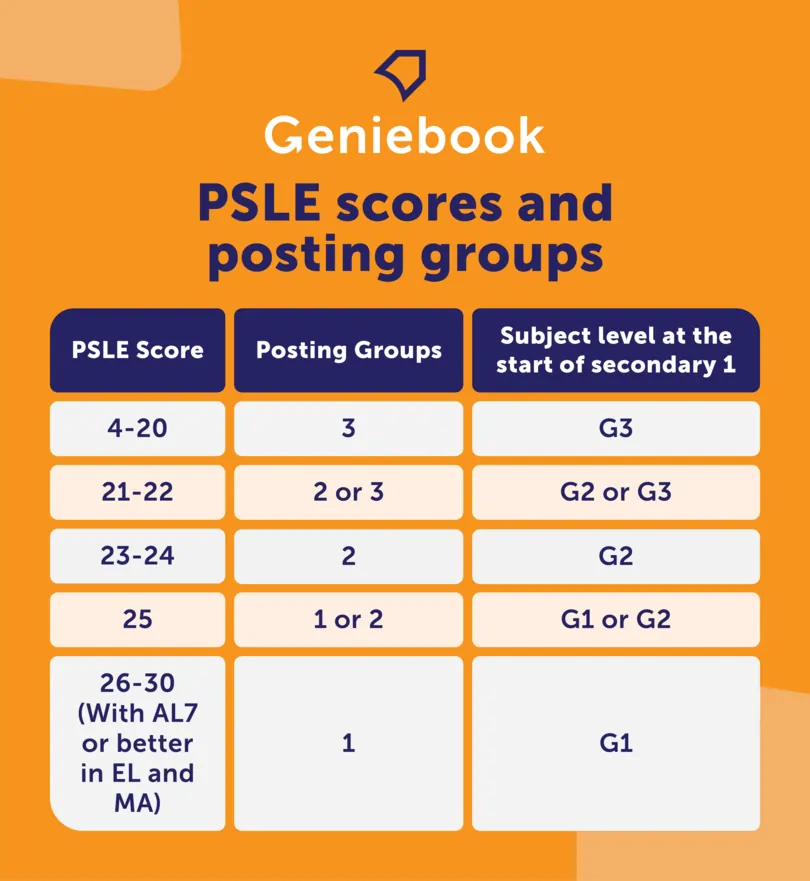
Your child’s PSLE score determines their Posting Group at the start of secondary 1. These groups guide the initial subject levels while allowing flexibility under Full Subject-Based Banding.
We order Posting Groups by academic strength:
- G3 is the strongest
- G1 is the most supported
These are not fixed tracks. They serve as starting points that schools adjust based on readiness, subject strengths and progress.
PSLE Score to Posting Group Mapping
What Each Posting Group Means
Posting Group G3 (Previously known as Express)
Students here take G3-level subjects for most areas at the start of secondary 1.
- Faster academic pace and greater depth
- Strong emphasis on analytical thinking and application
- Suitable for students who are academically ready for more demanding content
- Students may take selected G2 subjects if support is needed in specific areas
Posting Group G3 is designed for students who demonstrate strong mastery across subjects and are ready for higher academic demands.
Posting Group G2 (Previously known as Normal Academic)
Students here generally take G2-level subjects.
- Balanced academic pace
- Suitable for students with steady understanding across subjects
- Students may take:
- Some subjects at G3 level if they show strength
- Some subjects at G1 level if additional support is needed
Posting Group G2 offers flexibility, allowing students to stretch in stronger subjects while receiving support where required.
Posting Group G1 (Previously known as Normal Technical)
Students here generally take G1-level subjects.
- More structured and supported learning pace
- Strong focus on building core foundations in key subjects
- For PSLE scores 26 – 30, students must achieve at least AL 7 or better in English and Mathematics
- Students may take selected G2 subjects if they demonstrate readiness
Posting Group G1 supports students who benefit from a more gradual transition, while keeping progression pathways open.
How Posting Groups Support Progression Over Time
Under Full Subject-Based Banding, we view Posting Groups as pathways for progression rather than labels.
Many students progress from a more supported Posting Group to a stronger Posting Group over time, or take higher-level subjects (eg. G2 → G3) as they build confidence and mastery. This system encourages students to stay motivated, take ownership of their learning and actively seek opportunities to progress subject by subject, based on readiness and consistent effort.
Your child’s Posting Group is not an endpoint. It is a starting point that supports confidence, growth and long-term development.
PSLE Result Release Dates and Timeline
PSLE results are usually released in November. After receiving results, parents will proceed with:
- Secondary school selection
- Submission of school choices
- Secondary school posting results
Staying informed helps families plan calmly and confidently.
Frequently Asked Questions
What is the PSLE scoring system?
The PSLE scoring system uses Achievement Levels, or ALs, to measure how well a student has mastered each subject based on national standards set by MOE and SEAB. Instead of comparing students against one another, the system focuses on individual performance. Each student receives an AL grade for English, Mathematics, Science, and Mother Tongue. The four AL scores are added to form the overall PSLE Score, which is used for secondary school posting.
What is an AL score in PSLE?
An AL score reflects your child’s level of subject mastery, graded from AL 1 to AL 8. AL 1 represents the highest level of achievement, while AL 8 indicates that more support may be needed. Each AL corresponds to a specific mark range. The key difference from the old system is that your child is assessed against fixed achievement bands, not ranked against peers. This helps reduce excessive competition while maintaining academic rigour.
How is the PSLE AL score calculated?
The PSLE AL score is calculated by adding the Achievement Level scores from the four examinable subjects: English, Mathematics, Science, and Mother Tongue. Each subject is graded from AL 1 to AL 8. For example, if a student scores AL 2 for English, AL 3 for Mathematics, AL 2 for Science, and AL 4 for Mother Tongue, the total PSLE Score would be 11. Lower total scores indicate stronger overall performance.
What is the PSLE total score range?
The total PSLE Score ranges from 4 to 32. A score of 4 means the student achieved AL 1 in all four subjects, which reflects excellent mastery across the board. A score of 32 means the student received AL 8 for all four subjects. Since lower scores indicate stronger academic performance, students and parents should aim to reduce the total AL score through consistent improvement in each subject.
What is the difference between PSLE T-score and AL score?
The T-score system ranked students relative to their peers and used statistical moderation. A small difference in marks could lead to large differences in T-scores. In contrast, the AL system measures absolute performance against fixed standards. This means students are graded based on what they know and can do, not how others perform. The shift reduces fine differentiation and encourages meaningful learning rather than excessive score chasing.
How do PSLE scores affect secondary school posting?
Your child’s PSLE Score determines eligibility for different Posting Groups under Subject-Based Banding. Students are posted based on their total AL score, school choices, and available vacancies. Lower scores generally allow access to schools with more competitive cut-off points. Subject eligibility for Mathematics, Science, and languages in secondary school may also depend on individual AL grades. Strategic school selection plays an important role in the posting process.
Is there a passing mark for PSLE?
There is no official “pass” or “fail” mark for PSLE. All students can progress to secondary school. However, subject grades do determine eligibility for certain Posting Groups and subject combinations. For example, stronger performance may qualify students for more demanding academic pathways. Instead of focusing on passing, it is more helpful to focus on achieving steady mastery in each subject so your child keeps more options open for secondary education. Students who scored 31 or 32 in their PSLE need to either retake the exam or apply for admission to a specialised school like NorthLight or Assumption Pathway School.
My PSLE score is 21 - 22. Which Posting Group should I go for?
With a PSLE Score of 21 to 22, your child may be eligible for schools offering either Posting Group 2 or Posting Group 3, depending on subject AL grades and that year’s cut-off points. Choosing a school with Posting Group 2 is not inferior, as students can progress from G2 to G3 subjects if they show strong performance. Consider factors such as school programmes, CCA strengths, culture, facilities and location before making your choice.
Prepare Your Child for PSLE Excellence with Engaging Lessons at Geniebook CAMPUS
PSLE now emphasises on students’ mastery of concepts and ability to apply critical thinking over. At Geniebook CAMPUS, our engaging and structured lessons are thoughtfully designed to help students strengthen their concept clarity across all subjects.
By focusing on deeper understanding and critical thinking skills, these lessons equip your child to excel under the (AL) framework, giving them the confidence to tackle every PSLE challenge head-on.
Discover the difference at Geniebook CAMPUS!