


PSLE Score Calculator
PSLE AL Score Calculator
The PSLE score calculator converts raw marks (out of 100) into Achievement Levels (ALs) automatically and calculates your child’s total PSLE score instantly.
Instead of manually checking AL bands and adding numbers, simply key in the estimated raw scores for English, Mathematics, Science and Mother Tongue. The calculator converts them into AL scores and sums them up to give the final PSLE score out of 32.
Understanding how this works makes secondary school posting much clearer and far less stressful.
What Is the PSLE AL Score?
The PSLE AL score is the total of four Achievement Levels obtained from:
- English
- Mathematics
- Science
- Mother Tongue Language
Each subject is graded from:
- AL 1 (best performance)
- to AL 8 (lowest performance)
Your child’s total PSLE score ranges from:
- 4 (best possible total)
- to 32 (highest total score)
Lower total score = stronger academic performance.
Unlike the old PSLE T-score system, the current AL system measures students against fixed national standards, rather than against peers. This reduces extreme competition and large ranking gaps caused by 1–2 mark differences.
How the PSLE Score Calculator Works
The PSLE AL score calculator works in 2 simple steps:
- Select ‘Standard’ or ‘Foundation’ level for the respective subjects
- Key in the score out of 100
You will get the PSLE AL Score and the Posting Group that your child will be taking at the start of secondary 1. Let's find out!


PSLE AL Grading System Explained
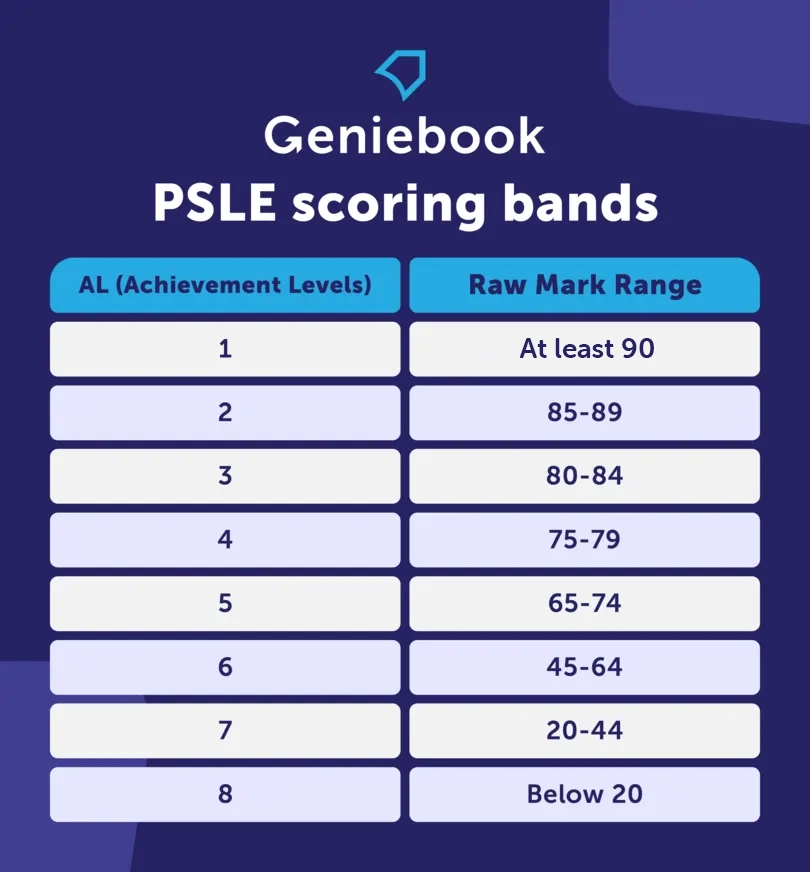
Here are the official MOE Achievement Level bands:
Important Insight
Notice that:
- AL 1 to AL 4 each has a smaller mark range.
- AL 5 to AL 8 each has a wider mark range.
This is why accurate conversion matters. The calculator prevents misinterpretation.
Achievement Levels (AL) and Bands
When parents search for PSLE AL band or AL score range, they usually want clarity on how total scores translate into posting.
Total PSLE Score Range
- Lowest possible: 4
- Highest possible: 32
Secondary Posting Groups (Full Subject-Based Banding)
Based on MOE’s posting framework:
|
PSLE Score Range |
Posting Group |
|
4 – 20 |
Posting Group 3 |
|
21 – 22 |
Posting Group 2 or 3 |
|
23 – 24 |
Posting Group 2 |
|
25 |
Posting Group 1 or 2 |
|
26 - 30 |
Posting Group 1 |
Important clarification:
- G3 is the strongest group
- G1 is the foundational group
Under Full Subject-Based Banding (FSBB), students can take subjects at different levels based on strengths.
For example, students who are scoring 21 to 22 take a mix of G2 and G3 subjects based on their individual subject results. Stronger subjects are assigned at G3 level. Others are assigned at G2 level.
- Maths at G3
- English at G2
- Science at G3
Students are not locked into one fixed stream and they can switch between the bandings depending on their ability and progress.
How to Calculate PSLE Score Manually
If you prefer to calculate without the PSLE score calculator:
Step 1: Convert Raw Marks to AL
Use the official AL band table.
Step 2: Add the Four AL Scores
Example:
English: 82 → AL 3
Maths: 94 → AL 1
Science: 77 → AL 4
MTL: 86 → AL 2
Total = 3 + 1 + 4 + 2 = 10
Manual calculation works, but many parents accidentally misread band cut-offs. The calculator removes this risk.
PSLE T-Score vs AL Score
Many parents still remember the PSLE T score.
Here’s the difference:
|
Old T-Score System |
Current AL System |
|
Bell-curve ranking |
Fixed standards |
|
Relative comparison |
Absolute benchmarks |
|
Small mark gap = big ranking change |
Stable band groupings |
|
Score range ~180–300 |
Score range 4–32 |
The AL system reduces unnecessary competition and focuses on mastery.
PSLE Scores and Secondary School Grading
After PSLE, students enter secondary school under Subject-Based Banding:
- G3 (Express level equivalent)
- G2: (Normal Academic equivalent)
- G1: (Normal Technical equivalent)
The old stream labels (Express, Normal Academic and Technical) are being phased out.
Why Posting Groups Matter More Than Ever
In my experience, many students progress upward over time.
We have seen students:
- Start in G2 subjects
- Improve consistently
- Move into G3 subjects
The system now encourages progression.
Common Myth Debunked
Myth: You must score AL 1 for every subject to succeed.
Reality:
- Secondary pathways are flexible.
- Students can move up subject levels.
- Academic growth continues beyond PSLE.
PSLE is a checkpoint, not a final label.
Pros and Cons of the AL System
|
Pros |
Cons |
|
|
FAQs
1. What is a PSLE AL score?
It is the total of four Achievement Levels converted from raw marks.
2. How does the PSLE score calculator work?
You enter raw marks out of 100. The calculator converts them into AL scores and sums them up. The eligible Posting Group will also be generated.
3. How is the PSLE score calculated?
Each subject’s raw mark is converted into an AL band, then added together.
4. What is the PSLE score range?
From 4 (best) to 32.
5. What do AL bands mean?
They represent performance levels within fixed mark ranges set by MOE.
6. What is the difference between PSLE T-score and AL score?
T-score ranked students relative to peers. AL measures mastery against fixed standards.
7. What is a good PSLE score?
Generally 4–14 is strong, but suitability depends on school choice.
8. How do PSLE scores affect secondary school placement?
They determine the Posting Group and influence school eligibility.