 SG
SG  VN
VN 

PSLE Maths Nets and Volume: A Guide to 3D Geometry

Why 3D Geometry Can Feel So Difficult
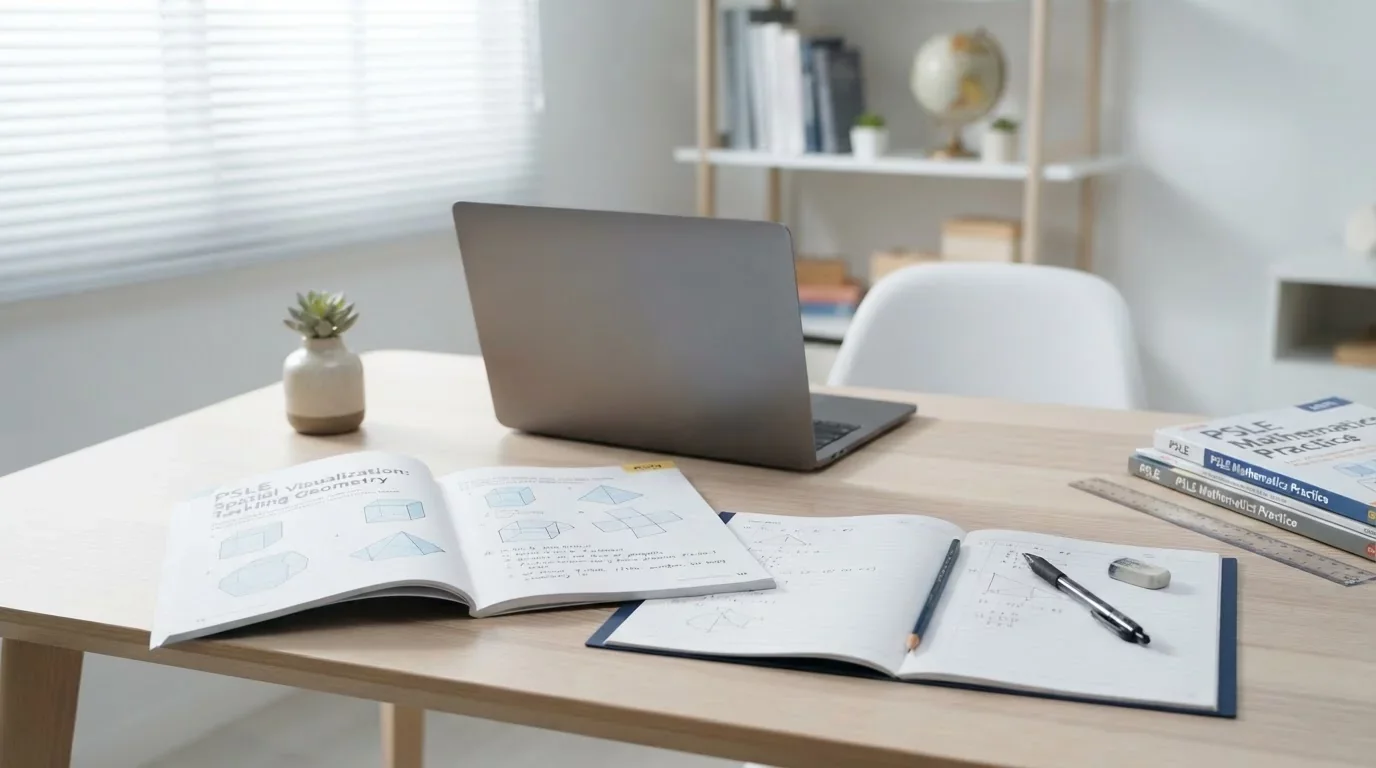
Many students who excel in other areas of maths find themselves stuck on questions about nets, volume and surface area. It is not a failure of logic. It is a challenge of spatial visualisation. This 'spatial visualisation gap' is the difficulty of mentally picturing a flat, 2D drawing folding into a 3D shape and it is a common hurdle in the MOE syllabus for Primary 4 onwards.
Seeing a net of six squares and knowing it forms a cube is one thing. Visualising how they connect, which face is opposite another and where they will sit in space is another skill entirely. This is the core challenge we need to address.
What Are Nets and How Are They Tested in the PSLE?
A net is the 2D pattern that can be folded to make a 3D solid. Think of it like unfolding a cardboard box until it is completely flat. For the PSLE, students need to identify correct nets from incorrect ones and sometimes draw them with precision.
- Cube: A cube has 11 unique nets. Students do not need to memorise all of them but they should be able to recognise a valid one.
- Cuboid: Its net is made of six rectangles.
- Prisms: These have two identical bases joined by rectangles. A triangular prism’s net will have two triangles and three rectangles.
- Cylinder: The net consists of two circles and one rectangle.
SEAB's Requirements for Drawing Nets
When a question requires drawing a net, the Singapore Examinations and Assessment Board (SEAB) looks for more than just the right shapes. Marks are awarded for:
- Connectivity: All faces must be connected correctly.
- Accurate Dimensions: The lengths and widths must be precise as given in the question.
Connecting Nets to Volume and Surface Area
It is easy for students to confuse volume and surface area under exam pressure. We must be clear on the difference.
- Volume is the total space *inside* a 3D object. It is measured in cubic units like cm³ or m³.
- Surface Area is the total area of all the faces on the *outside* of an object. It is measured in square units like cm² or m².
Nets are the key to calculating surface area. By 'unfolding' the shape into its 2D net, a student can simply find the area of each face and add them together. It turns a complex 3D problem into a straightforward 2D area calculation.
How to Tackle Challenging PSLE Geometry Questions
Let’s be realistic. The PSLE is designed to differentiate students. SEAB papers often include notoriously challenging PSLE math questions, strategically capped at around 15% of the exam, to identify the strongest pupils.
The classic problem type is the 'volume-of-water-in-a-tank' question. These multi-step problems might involve calculating water levels after a solid object is submerged or finding the volume of the unfilled portion of a tank. They test conceptual understanding and spatial visualisation skills, not just formula memorisation. These are the PSLE geometry questions that require a calm and systematic approach.
Practical Strategies for Your Child
So, how can we close the spatial visualisation gap and build confidence?
- Get Hands-On: Do not just look at diagrams. Print out nets, cut them out and fold them. Using physical models makes the 3D concepts tangible and much easier to understand. This is the first step to get them visualising with tangible items before they move on to visualising them without the items.
- Identify Bases First: Teach your child to always identify the base of the solid first. From there, they can systematically work out the other faces and how they connect.
- Work with Past Papers: There is no substitute for practice. Use past PSLE math questions to familiarise your child with the format and phrasing used by SEAB. This helps demystify what is being asked. Fret not, spatial visualisation can be trained through practices.
Tackling 3D geometry is a process. It requires patience and a different way of thinking but with the right strategies and consistent practice, these challenging PSLE math questions can become a strength.