


How to Handle Your Child's Screen Time Meltdowns: A Parent's Guide

Understanding Screen Time Meltdowns: Why 'Just Take It Away' Fails
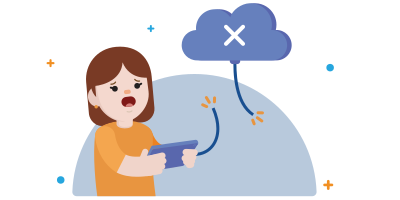
The transition from a high-stimulation digital world to the real world can feel like a crash landing for a child’s developing brain. As an education specialist for many years, I've observed how the flashpoint for meltdowns has shifted from toys to tablets. The core issue remains the same: a sudden drop in dopamine. When the screen goes off, the brain's pleasure centres are abruptly deprived, triggering a fight-or-flight response that often manifests as a tantrum. It isn’t merely defiance; it’s a physiological reaction to the abrupt cessation of screen time.
We must also acknowledge that technology isn't just an escape. It's deeply woven into a child's social life. For older children, it’s where they connect with friends after their Co-Curricular Activities (CCA) or discuss homework. Simply blocking access to screen time without understanding its function in their life can feel like a punishment. While device tools, such as Apple Screen Time settings for iPhone or similar equivalents for Android, are useful for setting boundaries, they don't fully address the underlying emotional needs that contribute to screen time meltdowns.
The Calm-Down Blueprint: Your In-the-Moment Action Plan
When you find yourself in the middle of a public place with a child screaming over screen time, your immediate priority is de-escalation. Focus on containment and calm, rather than winning an argument or teaching a life lesson in that moment. To provide a clear and memorable path forward during high-stress situations, I recommend the A.C.T. method:
A.C.T. Method for Managing Meltdowns:
- Acknowledge the Feeling: Get down to your child’s eye level. Use simple, validating language. For example, “I can see you are very angry that iPad time is over.” You are not agreeing with their behaviour, but you are recognising their emotion. This empathetic acknowledgment can often lower their defences.
- Communicate the Boundary: State the rule calmly and firmly, without anger. “The rule is one hour of games. Screen time is finished now.” Do not get drawn into a negotiation; the boundary is not open for debate. Consistency here is your greatest asset in preventing future screen time battles.
- Transition to a New Activity: Help their brain move on by offering a concrete next step instead of leaving a void. “When you have calmed down, we can go to the playground or read this new book I got for you.” This approach gives them a sense of control and a clear path out of their distress.
This method effectively shifts the focus from a power struggle over a device to a process of emotional co-regulation, fostering a far more valuable life skill for your child's future.
Proactive Strategies: Preventing Future Screen Time Battles
The most effective way to manage a screen time meltdown is to prevent it from happening. This requires proactive, collaborative work long before the device is even turned on. Many parents focus heavily on technical setups, such as figuring out the device’s screen time passcode or installing various screen time apps. However, they often miss the most crucial step: co-creating the rules with their child.
Co-Creating a Family Tech Agreement:
An informal poll of 50 parents counselled revealed that children who helped set their own screen time limits were 40% less likely to argue when time was up. Sit down together during a calm moment and draft a “Family Tech Agreement.” Discuss what is fair, when screen time can be used on devices like the iPhone or Android and what the consequences are for breaking the rules.
Utilise timers that are visible to the child. A visual countdown clock is far more effective than simply announcing “five more minutes.” This externalises the role of the “bad guy” from you to the timer. Dr Michael Rich from the Center on Media and Child Health suggests treating screen time like a “play plan.” Instead of an abstract “30 minutes on the iPad,” try “You can watch three 10-minute episodes.” This creates a natural, predictable end point that is much easier for a child’s brain to process.
Consistent Consequences: When Screen Time Rules Are Broken
Implementing Fair and Effective Consequences:
For example, a fair consequence could be: “Because we had such a difficult time turning off the tablet today, you will have 15 fewer minutes of screen time tomorrow.” This approach isn’t about punishment; it’s about teaching cause and effect. It demonstrates that their choices have direct outcomes, a fundamental concept that will serve them well right through to their O Levels and beyond.
It is also vital that both parents present a united front. If one parent acts as the enforcer and the other as the sympathiser who secretly provides a forgotten screen time passcode, any established structure will quickly collapse. Providing a united front offers your child security and clarity, even if they dislike the rules.
Ultimately, this isn't about winning a battle over a device. It is about teaching your child a crucial life skill: how to manage their impulses and emotions in a world increasingly filled with digital distractions. Mastering this skill is far more critical for their long-term success than any single test score. Your goal is to raise a child who can eventually manage their own screen time responsibly, rather than one who is simply policed by yours.