


Unlocking PSLE Maths: A Simple 5-Step At-Home Revision Routine to Build Deep Number Sense for P4–P6

Unlocking PSLE Maths: A Simple 5-Step At-Home Revision Routine To Build Deep Number Sense For Primary 4 To Primary 6
A simple, consistent at-home revision routine is one of the most effective ways to build the deep number sense required for PSLE Mathematics success. This structured approach moves beyond endless practice sheets, focusing instead on helping your child truly understand concepts from Primary 4 through Primary 6.
As a veteran of the Singapore education system, I've seen countless parents worry about the jump in difficulty, especially at Primary 5 and Primary 6. Many seek out extensive Primary Maths tuition, but the foundation for true mastery is often built in short, consistent bursts at home. The PSLE is not a test of memory. It's a test of application. Let's build a routine that prepares your child for exactly that.
Why Rote Memorisation Fails For PSLE Mathematics
Simply memorising formulas and drilling problem types is a strategy with diminishing returns. PSLE examiners design non-routine questions specifically to identify students who can think flexibly rather than those who only spot patterns. As noted by experienced educators, the most common roadblock isn't forgetting a formula. It's not knowing which concept to apply in the first place.
This is why building deep number sense, which is an intuitive understanding of how numbers and concepts relate, is critical. A child with strong number sense can visualise a problem, choose the right heuristic and translate a complex word problem into a solvable model drawing, which is a signature of the Singapore Maths syllabus.
The 5-Step Daily And Weekly At-Home Revision Routine
This at-home revision routine is designed to be highly manageable, taking just 30 to 45 minutes on most days. When it comes to PSLE Mathematics preparation, consistency is far more powerful than last-minute cramming. This structured approach helps build daily habits that turn exam anxiety into confidence.
Step 1: Quick Concept Micro-Reviews (10 Minutes)
Instead of a long and draining study session, spend just ten minutes revisiting one specific concept. This could involve finding a percentage, calculating the area of a triangle or converting fractions to decimals. This daily reinforcement keeps foundational knowledge fresh and ready to be applied under exam pressure. It is a highly effective way to keep your child's Primary 4 to Primary 6 preparation on track without causing burnout.
Step 2: Daily Mental Sums (5 Minutes)
Calculation speed and accuracy are vital for PSLE Mathematics Paper 1, where calculators are strictly prohibited. Spending just five minutes on mental calculations, such as simple addition, subtraction, multiplication and division, significantly sharpens numerical fluency. This simple habit helps eliminate the careless mistakes that often cost students precious marks under timed exam pressure.
Step 3: One Real-Life Word Problem (15 Minutes)
Connecting mathematics to the world around them helps students grasp abstract concepts much faster. Ask your child to solve one word problem contextualised to daily Singaporean life. For example, you could calculate the total cost of groceries with a 15% discount at FairPrice or figure out the travel time between two MRT stations. This approach makes primary school mathematics practical and significantly boosts problem-solving accuracy.
Step 4: The 'Smart Mistake Audit' (Your Child's Maths Diary)
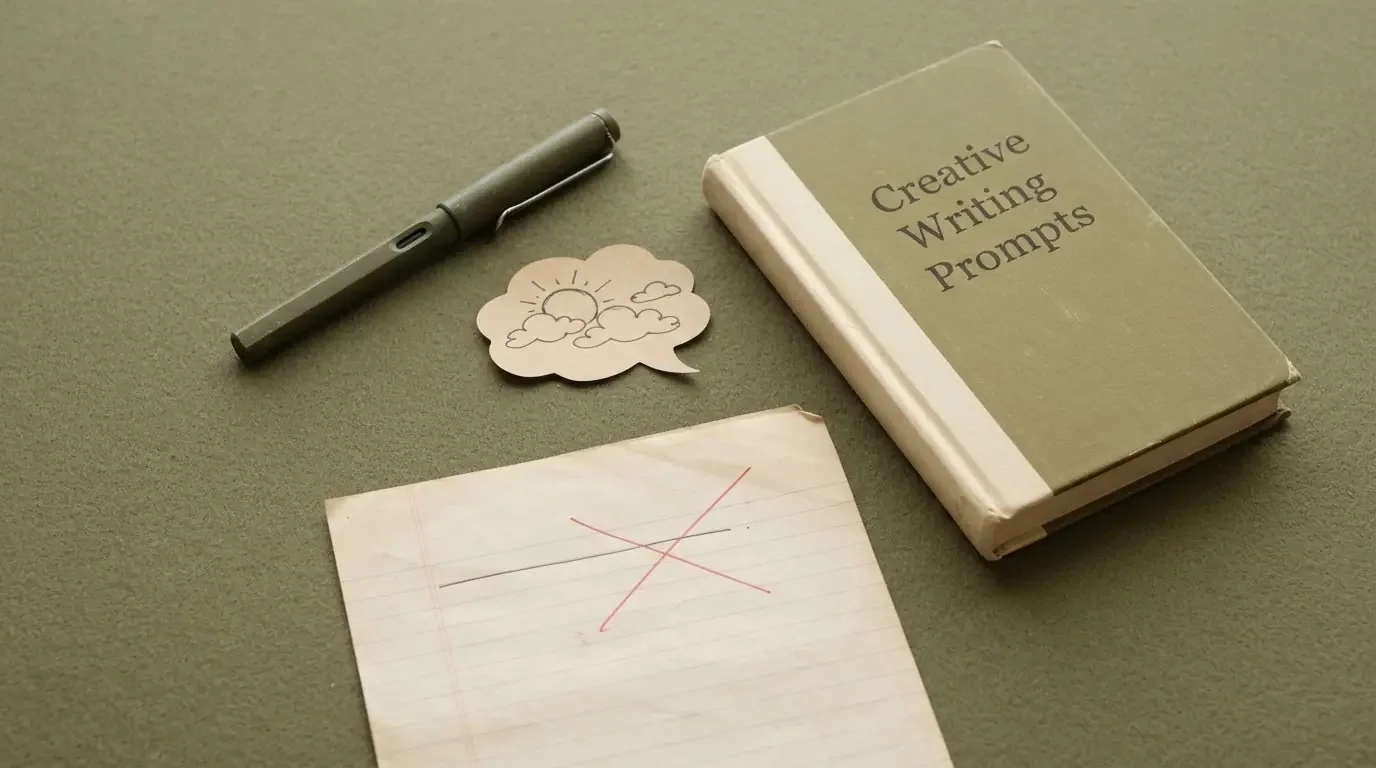
Rather than simply doing more practice papers, encourage your child to keep a dedicated mathematics diary. This 'smart mistake audit' shifts the focus from simply completing worksheets to understanding why errors occurred in the first place. Your child should record the problem they got wrong, document their original incorrect solution and analyse the exact reason for the mistake. Whether the error was due to a calculation slip, a misread keyword or a misunderstood concept, writing down the correct method and final answer transforms mistakes into valuable learning data.
To help them identify the root cause of each error, ask these three key questions:
- Did they make a concept error because they did not fully understand the topic?
- Did they make a careless mistake due to a calculation slip under pressure?
- Did they make a keyword error because they misread or misinterpreted the question?
Diagnosing the root cause of mistakes through this structured audit builds critical self-awareness, reduces frustration and directly targets their real academic weaknesses.
Step 5: Weekly Timed Mini-Quizzes With A Guided Review (45 Minutes)
Once a week, set a short, timed quiz consisting of five to seven questions covering recently revised topics. This exercise simulates real exam conditions, helps build crucial time management skills and reduces test anxiety.
The most important part of this step is the guided review that follows. Sit with your child and discuss the solutions using a scaffolding method. Instead of simply giving them the correct answer, ask guiding questions such as: "What is the question actually asking for?" or "Which model drawing strategy can we use to visualise this relationship?" This approach encourages active learning and helps them find the solution on their own.
How Does This Routine Adapt For Primary 4, Primary 5 And Primary 6?
While the five-step framework remains the same, the focus of the content will naturally shift as your child progresses.
-
Primary 4: Solidifying The Fundamentals: The main goal is to build a rock-solid foundation. Practice should centre on whole numbers, long division, basic fractions and early geometry. Consolidating these basics early ensures they are fully prepared for the academic transition ahead.
-
Primary 5: Bridging The Concepts: This is a critical transition year with a significant jump in mathematical complexity. The routine should focus on key topics such as ratios, percentages, area and volume. Train your child to identify constant variables and apply comparison and before-after heuristics.
-
Primary 6: The Final Push: In the final PSLE year, the emphasis shifts to exam readiness, advanced problem-solving speed and algebraic thinking. The routine should integrate timed practice for both Paper 1 and Paper 2. Focus on mastering composite figures, nested heuristics and reviewing common exam traps.
Is Primary Maths Tuition Still Necessary?
We understand that helping your child build mathematical fluency can feel like an incredibly stressful and demanding experience for busy families in Singapore. While Singapore schools do an excellent job of teaching the MOE syllabus, the large class sizes can make it difficult for teachers to provide the personalised attention some children need to master complex heuristics.
While a consistent at-home routine provides an essential foundation, a dedicated tutor or structured Primary Maths tuition programme can offer the close, personalised attention that is difficult to achieve in a large school classroom. Professional support provides exposure to a wider variety of problem-solving heuristics and helps diagnose persistent learning gaps. Ultimately, this five-step routine empowers you as a parent. It transforms revision from a nightly battle into a structured, manageable process that builds the confidence to excel.
Achieve Academic Goals With Geniebook's Tech-Enabled Suite
At Geniebook, our suite of online learning products is designed to complement your child's primary school preparation, helping Primary and Secondary school students learn smarter, stay on track and do better. We believe that when technology supports experienced educators, your child is fully empowered to close their learning gaps and achieve their academic potential.
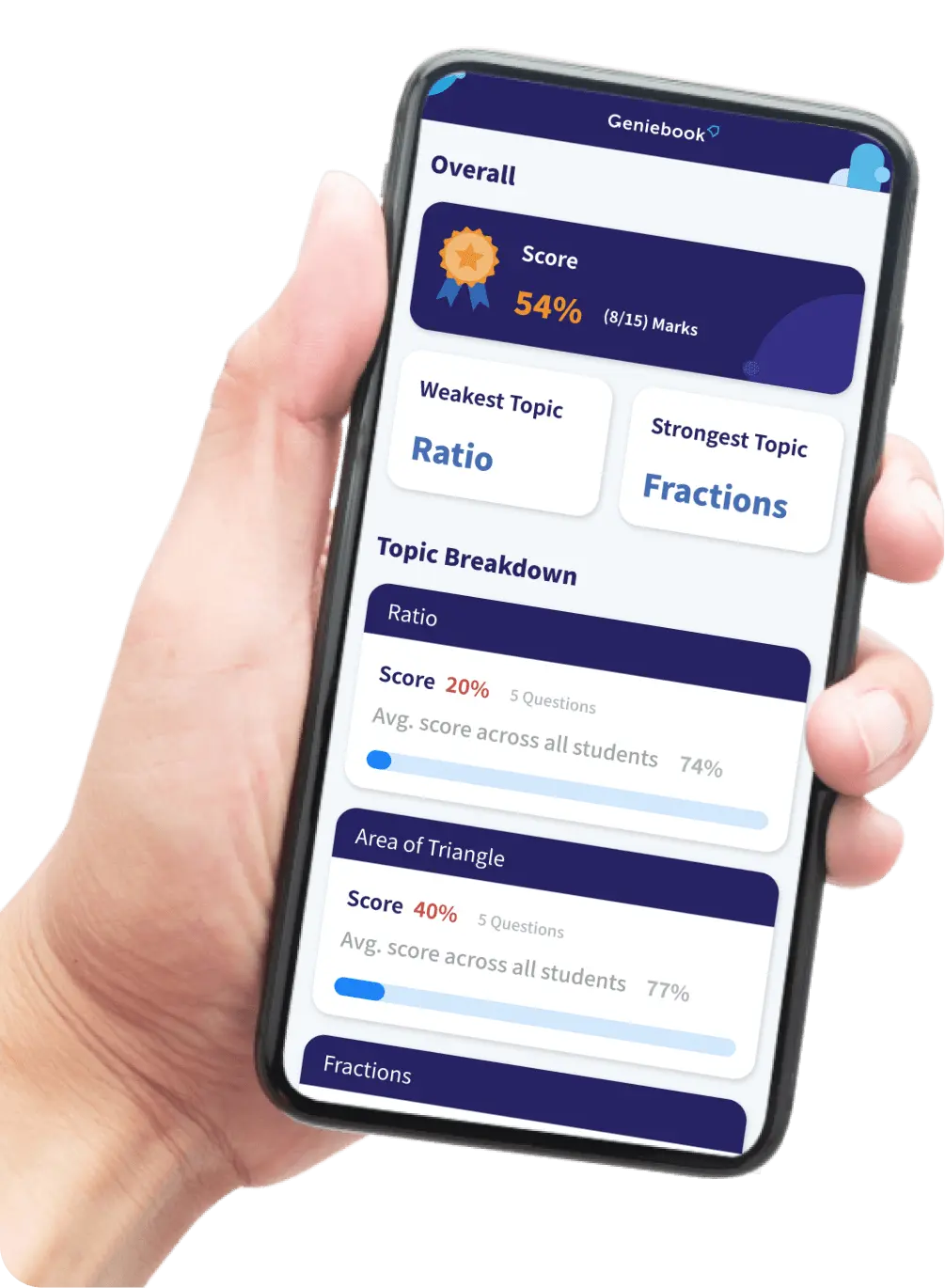
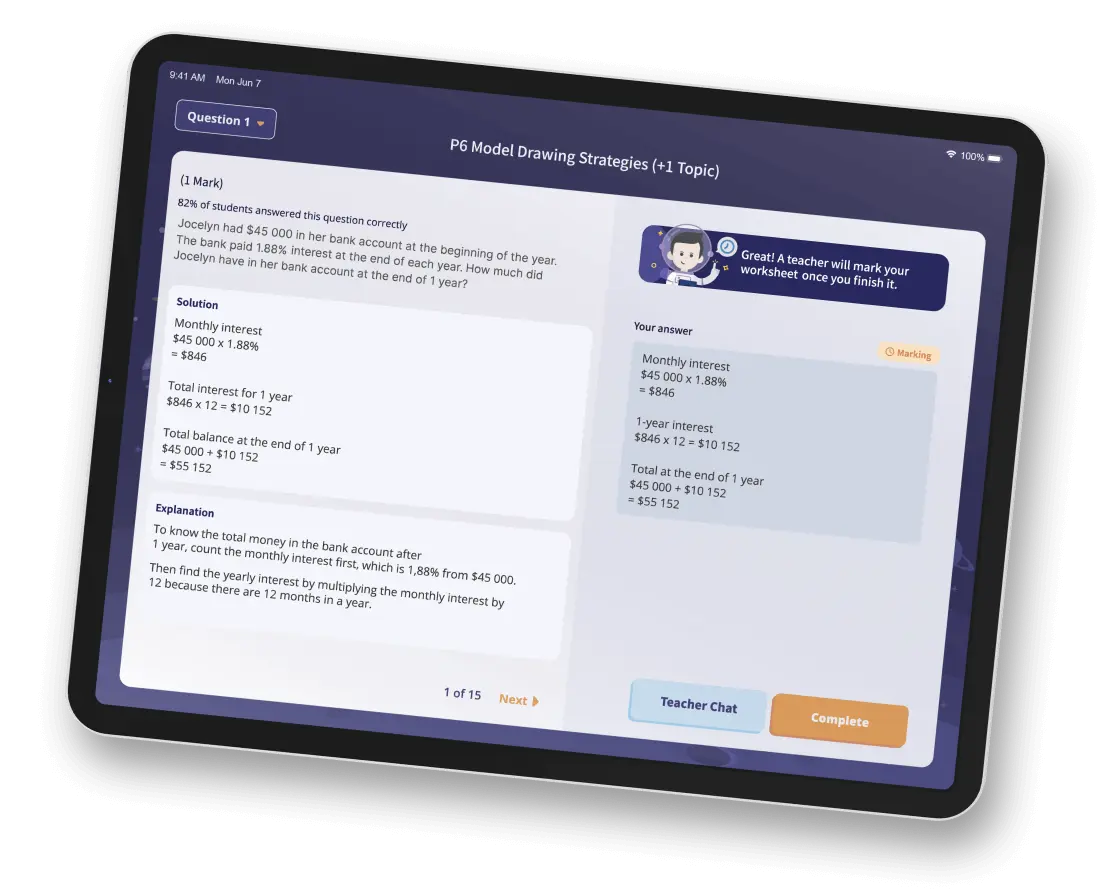
Through GenieSmart, our AI-personalised worksheets recommend targeted practice questions strictly aligned with the MOE syllabus, with difficulty levels that constantly adjust to your child's mastery of each topic. With over 300,000 questions in our database, our proprietary AI algorithm leverages over 1,000,000 data points to identify strengths and learning gaps. On GenieClass, experienced educators lead weekly live online classes, explaining complex English grammar, synthesis rules and comprehension strategies using storytelling, live polls and interactive visual aids.
If your child has doubts or needs help with homework, they can clarify concepts instantly through our real-time teacher chat on GenieAsk, which offers continuous support seven days a week. Additionally, our unique rewards system motivates students to learn independently. As your child completes worksheets and participates in classes, they earn Bubbles that can be redeemed for over 5,000 exciting, kid-safe items from our Bubble Store, turning daily practice into a rewarding habit. With half of our students successfully achieving AL 1 to AL 3 in PSLE and jumping two grades on average, we believe our personalised pedagogy is highly effective in building academic confidence. Have you planned how to help your child stay focused and on track for their upcoming examinations?