


PSLE Maths Time Strategy: Guide for Paper 1 & 2 | Geniebook

To execute an effective PSLE Maths time strategy, Primary 6 students should allocate 1 minute per mark for Paper 1 (70 minutes total for 50 marks, leaving a 20-minute checking buffer and harder questions) and 1.2 minutes per mark for Paper 2 (80 minutes total for 50 marks). This pacing preserves at least 20 minutes at the end of Paper 2 to resolve complex 4-mark and 5-mark heuristic problem sums without rushing.
Managing the clock across both papers requires distinct tactical choices. Paper 1 tests speed, mental computation and error-free shading on the optical answer sheet without calculator support. Paper 2 tests stamina, step-by-step layout and efficient calculator usage. Getting these timing details right is often what separates an AL 1 score from an AL 3.
How should students allocate time between Paper 1 and Paper 2?
Many Primary 6 students falter not from a lack of subject knowledge but because they spend seven or eight minutes stuck on a single question early in the exam. Understanding the SEAB paper structure allows students to set realistic pace targets from the opening bell.
| Paper Component | Format & Tools | Marks | Duration | Target Pace | Checking Buffer |
|---|---|---|---|---|---|
| Paper 1: Booklet A | 18 MCQs (No Calculator) | 26 | ~26 mins | 1 min to 1.5 mins per mark | 20 mins (Combined Paper 1) |
| Paper 1: Booklet B | 12 Short Answer (No Calculator) | 24 | ~24 mins | 1 min per mark | Included in 20-min buffer |
| Paper 2: Short Answer | 5 Short Answer (Calculator allowed) | 10 | ~12 mins | 1.2 mins per mark | 20 mins (Combined Paper 2) |
| Paper 2: Structured Long Answer | 10 Long Answer (Calculator allowed) | 40 | ~48 mins | 1.2 mins per mark (~5 mins per 4-mark item) | Included in 20-min buffer |
Mastering Paper 1: Speed, accuracy and mental arithmetic
Paper 1 carries 50% of the total PSLE Maths score. Because calculators are prohibited, students frequently lose time performing long manual calculations in working margins. Strong performance in standard Primary Maths relies heavily on fluent recall of basic multiplication tables and fraction-decimal conversions.
The 60-second pacing rule for Booklet A
Booklet A contains 10 one-mark questions followed by 8 two-mark questions. Questions 1 to 10 cover core concepts like place values, rounding and simple estimations. Your child should aim to clear each one-mark question in under 60 seconds.
Questions 11 to 18 introduce multi-step logic. Keep a strict cap of 90 seconds per question here. If an answer remains unclear after a minute and a half, circle the question number, shade an educated guess on the optical answer sheet immediately and move forward. Never leave an optical answer sheet circle blank.
Bypassing arithmetic speed traps in Booklet B
Booklet B demands exact numerical answers without options to choose from. A frequent timing trap involves brute-forcing manual long division or large-number multiplication. Teach your child to simplify expressions first. Factoring out common multiples early cuts calculation time in half.
Pro-Tip for Paper 1 Efficiency
If a short-answer question takes more than two minutes of continuous written working, your child is using an inefficient brute-force method. Train them to pause and look for underlying structural patterns like constant difference, constant total or equal stage remaining.
Mastering Paper 2 with targeted support and heuristic pacing
Paper 2 accounts for 50% of the overall grade. It consists of 5 2-mark short-answer questions followed by 10 structured problem sums carrying 3 to 5 marks each. This paper tests deep problem-solving skills, logic and emotional resilience.
Recommended Paper 2 Time Allocation (80 Minutes Total)
Questions 1–5 (10 Marks) : 10–12 Minutes (Speed & Accuracy)
Questions 6–15 (40 Marks) : 45–48 Minutes (Mid-Tier Problems & High-Mark Heuristics)
Final Verification & Checking : 15–20 Minutes
Tackling high-mark heuristic problem sums
The last 5 to 6 questions form the main challenge of Paper 2. These 4-mark and 5-mark word problems test complex models, remainder concepts and spatial visualisation. To prevent running out of time during these final questions, students should follow a clear three-step routine:
- Annotate on the first pass: Underline key phrases like "fraction of the remainder" during the initial reading. Misinterpreting the baseline value costs crucial minutes in rewrites.
- Label working steps clearly: Write distinct stage markers such as Before, Change and After. Neat organisation speeds up self-checking later and ensures partial method marks awarded by markers even if a calculation error occurs.
- Enforce the 6-minute cutoff: If a child remains stuck on a 5-mark question for more than 6 minutes, they must leave a gap and advance to the next problem. Securing sub-questions downstream is far better than burning 12 minutes chasing a single final answer.
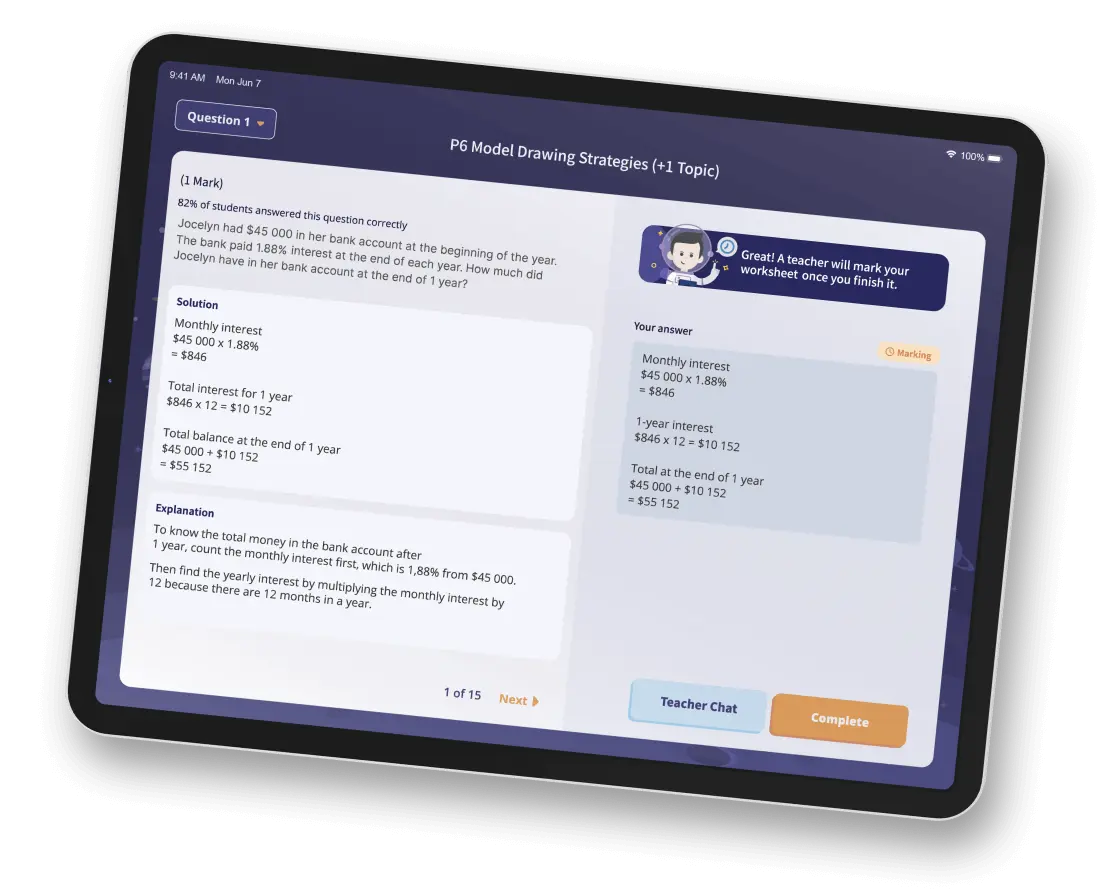
Students can tackle challenging concepts systematically through progressive topical mastery. You can identify learning gaps and maximise improvement intelligently with AI-personalised worksheets from GenieSmart. Our proprietary AI algorithm analyses over 1 million data points to recommend questions that focus on specific areas of improvement. The difficulty of questions constantly adjusts to your child's mastery level.
Choosing CAMPUS as the right Primary Maths tuition for exam preparation
Timing issues often stem from deeper gaps in conceptual understanding or unfamiliarity with exam-style heuristics. Quality Primary Maths tuition provides structured practice to turn passive knowledge into speed and accuracy.
Physical classes at Geniebook CAMPUS
Your child can accelerate learning and reinforce exam techniques at Geniebook CAMPUS. Experienced teachers use interactive smartboards and personalised dashboards to deliver engaging lessons. We curate learning materials aligned with the latest MOE syllabi. Parents receive detailed monthly progress reports to track improvement and set clear academic goals together.
Support learning beyond the classroom
Motivate your child to learn independently with our Learning Rewards system. Students earn Bubbles as they complete practice modules and participate in live online sessions. They can redeem these Bubbles for over 5,000 kid-safe items in the Bubble Store. Rewards tied directly to effort keep children engaged while building long-term academic confidence.
Build speed with consistent timed practice
Building exam stamina requires months of structured, routine practice. Setting a timer for weekend practice at 8:30 AM simulates actual morning test conditions, helping reduce anxiety on exam day.
Students can reinforce key concepts anytime through live online classes led by experienced teachers in GenieClass. Educators make lessons engaging through interactive quizzes and real-time demonstrations that clarify complex heuristic steps. When students encounter difficult homework problems, they can get instant help through real-time chats with teachers on GenieAsk.
For more insights on tackling tricky exam scenarios, explore our guide on PSLE Maths revision strategies to help your child prepare for challenging questions.
Track consistent progress in Primary Maths
Monitoring academic growth can be difficult for busy parents. Having clear visibility into your child's learning process makes it easier to provide timely support before national examinations approach.
Stay informed with the Parent App
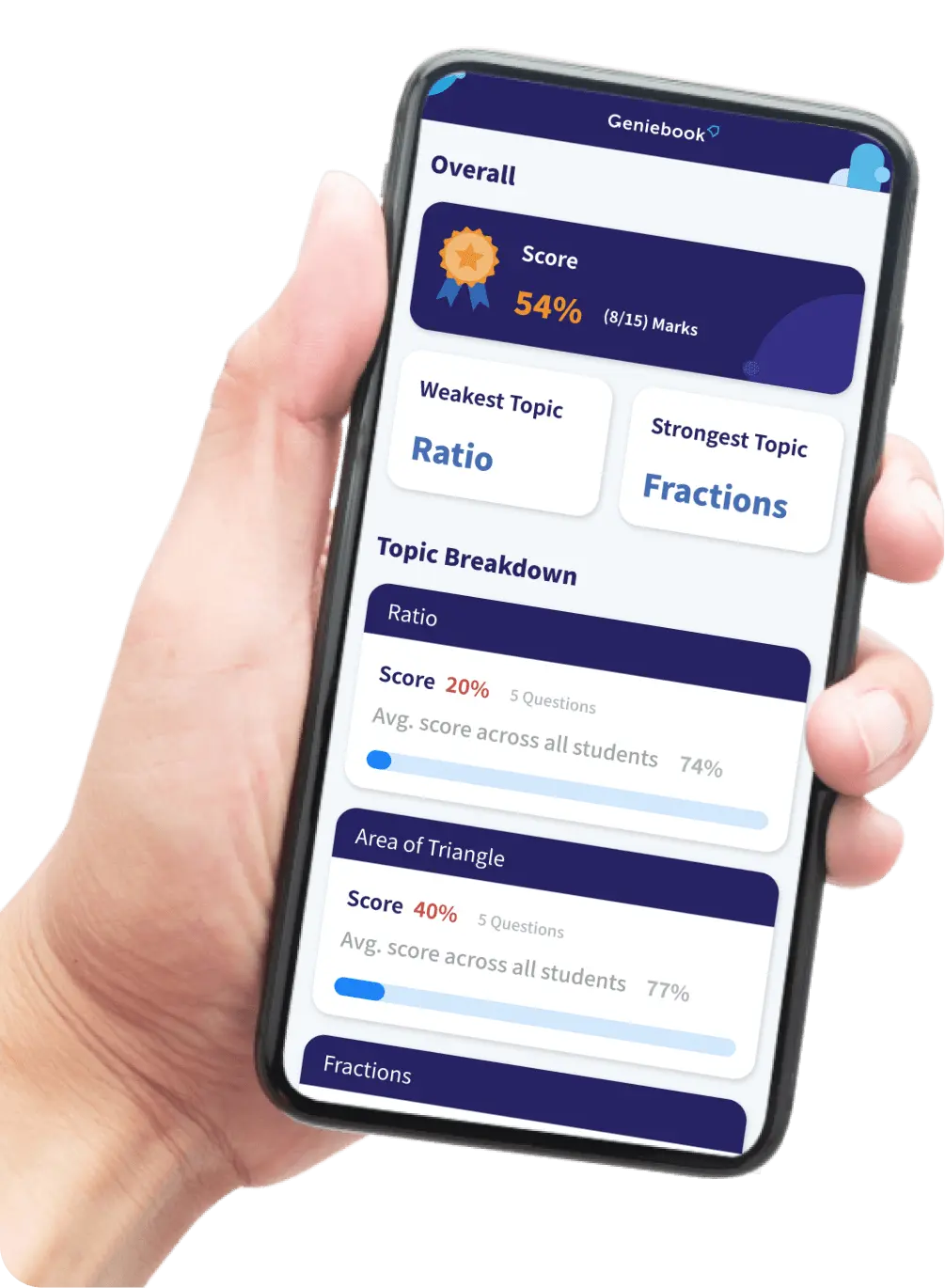
The Geniebook Parent App offers a clear view of your child's daily progress. You can easily set study schedules and assign customised worksheets to keep revision on track. You will receive monthly progress reports tailored to your child's activity and performance.
Build confidence for the final examinations
Connect with dedicated Learning Advisors who serve as personal motivators for your child. They help students stay on track with their goals and encourage consistent effort. You can also award extra Bubbles through the app to celebrate milestones and build confidence as exam day approaches.
Achieve academic goals with proven methods
Overcoming exam anxiety requires the right balance of strategy, practice and personal encouragement. With a combined database of over 300,000 questions, students can review concepts at their own pace and build familiarity with every question type.
Our platform supports over 300,000 users across Singapore to learn smarter and achieve their goals. Past data shows that 1 in 2 Geniebook students achieved AL 1 to AL 3 in PSLE Maths. To learn more about our personalised approach, discover how Geniebook prepares primary students for PSLE.
Global recognition, including being named in the GSV 150 list of leading Edtech companies, reflects our commitment to effective learning. Giving your child structured tools and guided support builds both mathematical mastery and lasting confidence for the final exams.