


AI-Powered PSLE English Writing: A Practical Playbook for Safe and Effective AI-Assisted Revision

Overcoming the Hurdles of PSLE Composition Writing
We understand that helping your child navigate the primary school English syllabus and cope with the high-pressure PSLE English preparation can feel like an incredibly stressful and demanding experience for busy families in Singapore. Specifically, we observe that primary 5 and primary 6 students often struggle to structure their compositions clearly and express their ideas with vocabulary that stands out under exam conditions. We believe that by mastering structured writing workflows and choosing the right academic support, your child is fully empowered to close their learning gaps, stay on track and achieve their academic potential.
In the PSLE English paper, Paper 1 (Writing) accounts for 27.5% of the total score, making it a critical component that often decides whether a student secures an AL 1 or AL 2. Many parents find that despite hours of revision and drilling past-year papers, their child's marks for continuous writing remain stagnant. The issue is rarely a lack of ideas. Rather, it is a difficulty in translating those ideas into a cohesive, well-structured narrative using varied sentence structures and precise vocabulary. While traditional primary English tuition can help, the integration of smart, offline and online technology can significantly accelerate this revision process.
The 3-Stage Playbook for AI-Assisted English Revision
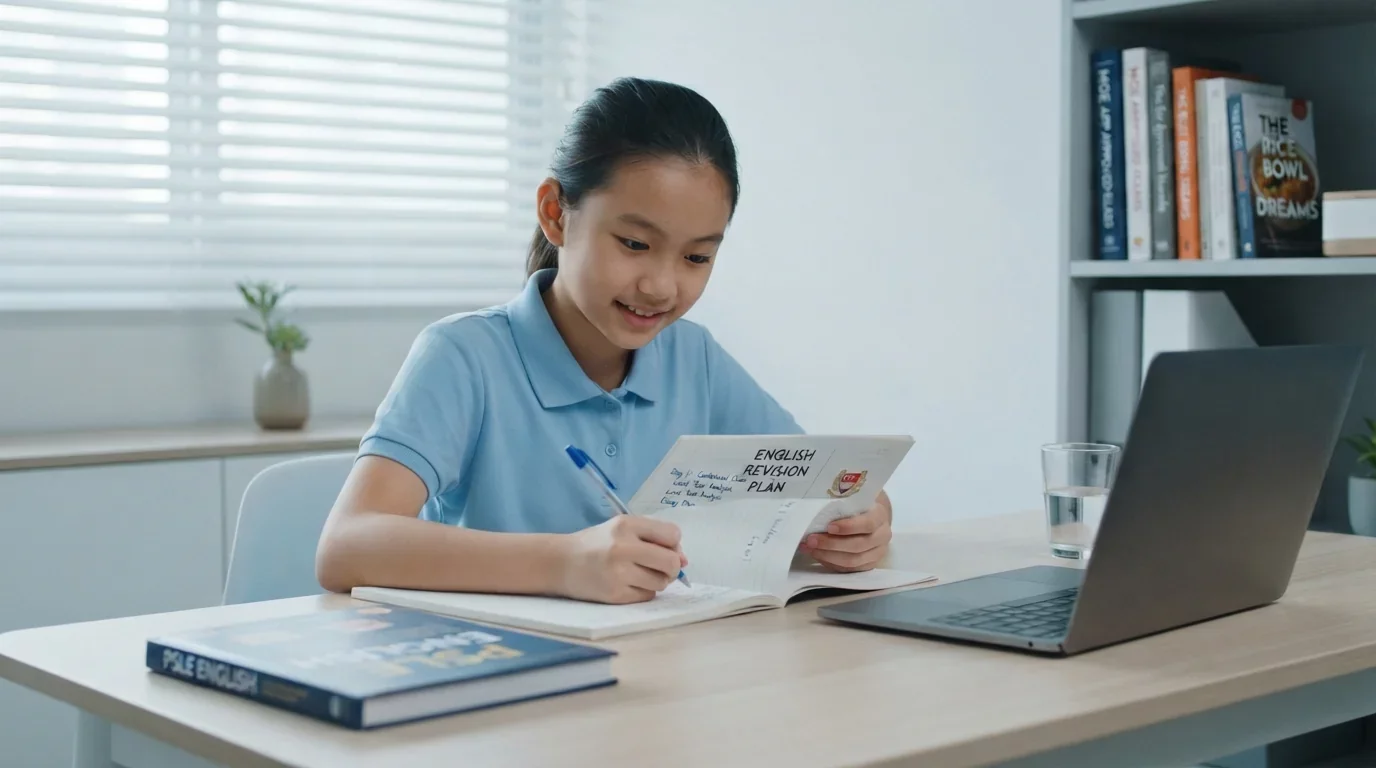
To write a compelling composition under timed conditions, students must move away from unstructured brainstorming and follow a disciplined process. Using artificial intelligence as a personalised learning partner allows students to receive immediate feedback, refine their drafts and build confidence. Here is a practical three-stage playbook to guide your child's AI-assisted revision safely and effectively.
Stage 1: Deconstructing the Prompt and Planning the Story Arc
Before putting pen to paper, students must analyse the exam topic and the three provided pictures. A common mistake is rushing to write, which often results in disjointed plots or out-of-point narratives. Teach your child the 5-30-5 method to manage their 50 minutes under exam conditions:
- 5 Minutes (Planning): Deconstruct the prompt and draft a clear story arc comprising a beginning, a conflict and a resolution.
- 30 Minutes (Writing): Write the composition, maintaining focus on the plot's progression and character development.
- 5 Minutes (Editing): Review the entire piece to edit for spelling, punctuation and grammatical errors.
During revision, your child can type their plan into an AI tool and ask: "Does this story arc logically address the topic and connect the pictures?" This offers an instant check on their narrative's coherence before they begin writing.
Stage 2: Elevating Expression Through Active Vocabulary and Collocations
Many students lose crucial marks under the 'Expression' rubric because they rely on passive memorisation of cliché idioms that feel forced. Examiners prefer natural, sophisticated phrasing. Instead of drilling static word lists, use AI to help your child learn words in chunks, known as collocations.
For example, if your child writes: "She was very happy," they can ask the AI to suggest three varied sentence structures using the 'Show, Don't Tell' method. The AI might provide: "She beamed with joy," or "Her face lit up with a brilliant smile." This active translation helps students understand how to describe emotions through physical actions and internal thoughts, which is a key exam technique heavily emphasised in specialised Primary 6 English tuition.
Stage 3: Escaping the 'Answer Machine' Trap With Active Recall
While AI is an incredibly powerful revision partner, it poses a major danger: the "answer machine" trap. If a child simply asks the AI to write their composition for them, they engage in passive consumption. This creates a false sense of accomplishment while doing nothing to build their actual skills.
To ensure revision remains active and effective, parents must establish clear boundaries:
- Generate Suggestions, Not Stories:
Use the AI solely to audit student drafts, suggest vocabulary alternatives or point out grammatical errors. Never let the AI write the essay from scratch.
- Build Screen-Free Active Recall:
Once your child has reviewed the AI's suggestions, they must close the device and handwrite their final draft on paper. The physical act of writing builds muscle memory and stamina for the exam hall.
- Track Recurring Errors:
Maintain an error log of common grammatical slips (such as Subject-Verb Agreement or tense inconsistencies) identified during AI audits, allowing for targeted practice before exam day.
Transforming Writing Habits Into Exam-Ready Confidence
Ultimately, scoring well in continuous writing is about developing a repeatable, reliable process. Combining structured home routines with professional guidance ensures your child's efforts translate into measurable academic success. Seeking a tuition partner that leverages technology to provide personalised insights can help your child navigate this critical transition year with confidence.
Mastering Situational Writing: Tone, Format and the PAC Framework
Situational writing is a highly scoreable section of PSLE English Paper 1, accounting for 14 marks. Unlike continuous writing, which demands a high degree of creative storytelling, situational writing is a direct test of task fulfilment, formatting accuracy and tone control. Many students lose marks not because of weak grammar, but because they fail to address every content point in the prompt or use an inappropriate tone for their audience.
Decoding the PAC Framework With AI
To secure full marks in situational writing, students must learn to analyse every question systematically before writing. Top-performing students rely on the PAC framework (Purpose, Audience and Context) to ensure their writing is aligned with examiner expectations.
- Purpose:
Why is the student writing? Is it to inform, persuade, complain, invite or request? Identifying the purpose defines the core message of the piece.
- Audience:
Who is the reader? Is it a school Principal, a classmate, a teacher or a neighbourhood resident? The audience determines whether the tone must be formal or informal.
- Context:
What is the situation? This involves identifying and numbering every content point given in the visual text and accompanying instructions to ensure no details are missed.
The 4-Step Situational Writing Strategy
To prevent careless errors, guide your child to follow this disciplined 4-step process during their revision:
1. Analyse:
Read the scenario carefully. Identify the Purpose, Audience and Context, then number every required content point on the question paper.
2. Plan:
Outline the structure of the letter, email or report. Determine where each content point will be logically inserted and choose the appropriate opening and closing greetings.
3. Write:
Draft the response, focusing on tone consistency and complete coverage of all numbered points.
4. Check:
Review the draft to catch spelling, punctuation and grammatical errors, checking off each content point against the question paper.
Using AI to Audit Tone and Format
Artificial intelligence can act as an endlessly patient revision partner, allowing your child to practice writing independently and receive instant feedback. When your child writes a draft, they can type it into an AI tool and ask specific questions to audit their work:
- "Is this email to my school Principal formal enough, or does it sound too casual?"
- "Are there any contractions like 'don't' or 'can't' in this formal letter that I should expand to build a more professional tone?"
- "Have I used a polite and respectful greeting and sign-off appropriate for a senior officer?"
This interactive feedback loop teaches students to recognise subtle shifts in language register, helping them internalise the differences between formal reports and casual letters to friends, a key exam technique heavily emphasised in specialised Primary 6 English tuition.
Navigating the New MOE Syllabus: Article Writing
The primary school English curriculum has evolved to test higher-order thinking and real-world communication. The introduction of 'article writing' as a text type in situational writing has created some anxiety for parents, as there is no single fixed template. This change is intentional, designed by the Ministry of Education (MOE) to encourage critical thinking over rote memorisation.
When tackling article writing, students must focus on creating engaging headings, structured body paragraphs and clear call-to-actions. During revision, your child can use AI to explore different ways to hook the reader. For example, they can input a topic like a school recycling drive and ask the AI: "Give me three different engaging headlines and opening hooks for a school newsletter article." This active analysis helps students understand how to capture an audience's attention logically, which is a major focus for any forward-looking primary English tuition centre.
Cracking Paper 2: The 47.5% Score-Decider
If Paper 1 is a test of creative expression and structure, Paper 2 (Language Use and Comprehension) is the ultimate test of rule-bound precision and analytical reading. Accounting for a massive 47.5% of the total PSLE English grade, Paper 2 is the decisive battleground where grades are determined. Many parents find that even children who are avid readers can struggle to secure top marks in Paper 2 because they fail to meet the unforgiving marking criteria set by the Singapore Examinations and Assessment Board (SEAB). Under these strict rubrics, a single punctuation slip, a minor shift in meaning during sentence synthesis or copying a word too many in comprehension open-ended questions can result in an automatic zero. Fortunately, when used strategically, artificial intelligence can act as a precise, 24/7 grammar coach to help your child master these rules and build exam-day stamina.
Transforming Synthesis and Transformation Into a Predictable Puzzle
The Synthesis and Transformation (S&T) section is worth a crucial 10 marks. Many students treat S&T like a guessing game, writing what "sounds correct" rather than applying systematic grammatical rules. This approach is highly risky because the number one rule of S&T is that the original meaning of the sentences must be perfectly preserved. Even a minor, subtle shift in meaning results in zero marks.
Mastering Reported Speech With Systematic Rules
Reported speech is one of the most frequently tested and historically tricky patterns in S&T. It requires students to apply several grammatical shifts simultaneously. Instead of leaving this to chance, teach your child to use a strict mental checklist when converting direct speech to indirect speech:
- The Backshift Rule:
Change the tenses one step back into the past (such as "is" to "was", "will" to "would" and "has finished" to "had finished") if the reporting verb is in the past tense.
- Pronoun Perspective:
Adjust all pronouns (such as "I" to "he" or "she" and "my" to "his" or "her") to reflect the perspective of the person reporting.
- Time and Place Markers:
Update context anchors (such as "tomorrow" to "the next day", "yesterday" to "the previous day" and "here" to "there").
- Question-to-Statement Transformation:
Convert direct questions into statements, switching the word order from verb-subject to subject-verb and removing the question mark.
Using AI as an Instant S&T Corrector
During independent revision, your child can use AI to audit their S&T practice without waiting days for homework marking. If they are unsure about a difficult transformation involving concessive phrases like "despite" or conditionals with "unless", they can type their attempt into the AI and use this prompt: "Review this Synthesis and Transformation sentence. Did I preserve the exact meaning of the original sentences, and are there any grammatical errors in my phrasing?" The AI will instantly highlight any subtle errors, helping your child build the necessary muscle memory for recurring grammatical patterns, a key skill drilled in specialised primary English tuition.
Conquering Comprehension Open-Ended Questions Without Lifting
The 20-mark Comprehension Open-Ended (COE) section in Paper 2 is often where the battle for an AL1 is won or lost. In this section, examiners award marks for content only, and no half-marks are given. A common pitfall is "lifting" (copying entire sentences directly from the passage). For many question types, especially "In Your Own Words" or inferential questions, direct lifting guarantees zero marks.
To score full marks, students must actively paraphrase, extracting the core meaning and expressing it using their own vocabulary and sentence structures while keeping key details intact. Your child can leverage AI to build this essential skill. They can paste a complex paragraph from a practice passage and ask the AI: "Paraphrase this paragraph in three different ways, using simpler sentence structures suitable for a primary school student. Highlight the key facts that must be preserved." By comparing these variations, students learn how to deconstruct complex texts and express ideas with precision and clarity.
Unlocking Vocabulary Cloze With Context-Clue Analysis
The Cloze Passage sections in Paper 2 test a child's deep understanding of vocabulary and language flow in context. Rote learning long word lists is a poor strategy because words must be understood in their natural partnerships, known as collocations. For example, students must learn that we "make a decision" rather than "do a decision", and "torrential rain" is a more precise collocation than "strong rain".
Teach your child to think like a detective by using a context-first approach to decode unfamiliar words. They can circle clue words before and after a blank to determine the required part of speech or emotional connotation. During revision, your child can input a paragraph into an AI tool and ask: "Generate three contextual vocabulary questions based on this paragraph. Provide clues that help me infer the meaning of the target words." This active retrieval process builds stronger neural pathways and long-term retention far more effectively than passive reading, a diagnostic approach that top-performing tutors consistently advocate.
Achieve Academic Goals With Geniebook's Tech-Enabled Suite
At Geniebook, our suite of online learning products is designed to complement your child's primary school preparation, helping primary and secondary school students learn smarter, stay on track and do better. We believe that when technology supports experienced educators, your child is fully empowered to close their learning gaps and achieve their academic potential.
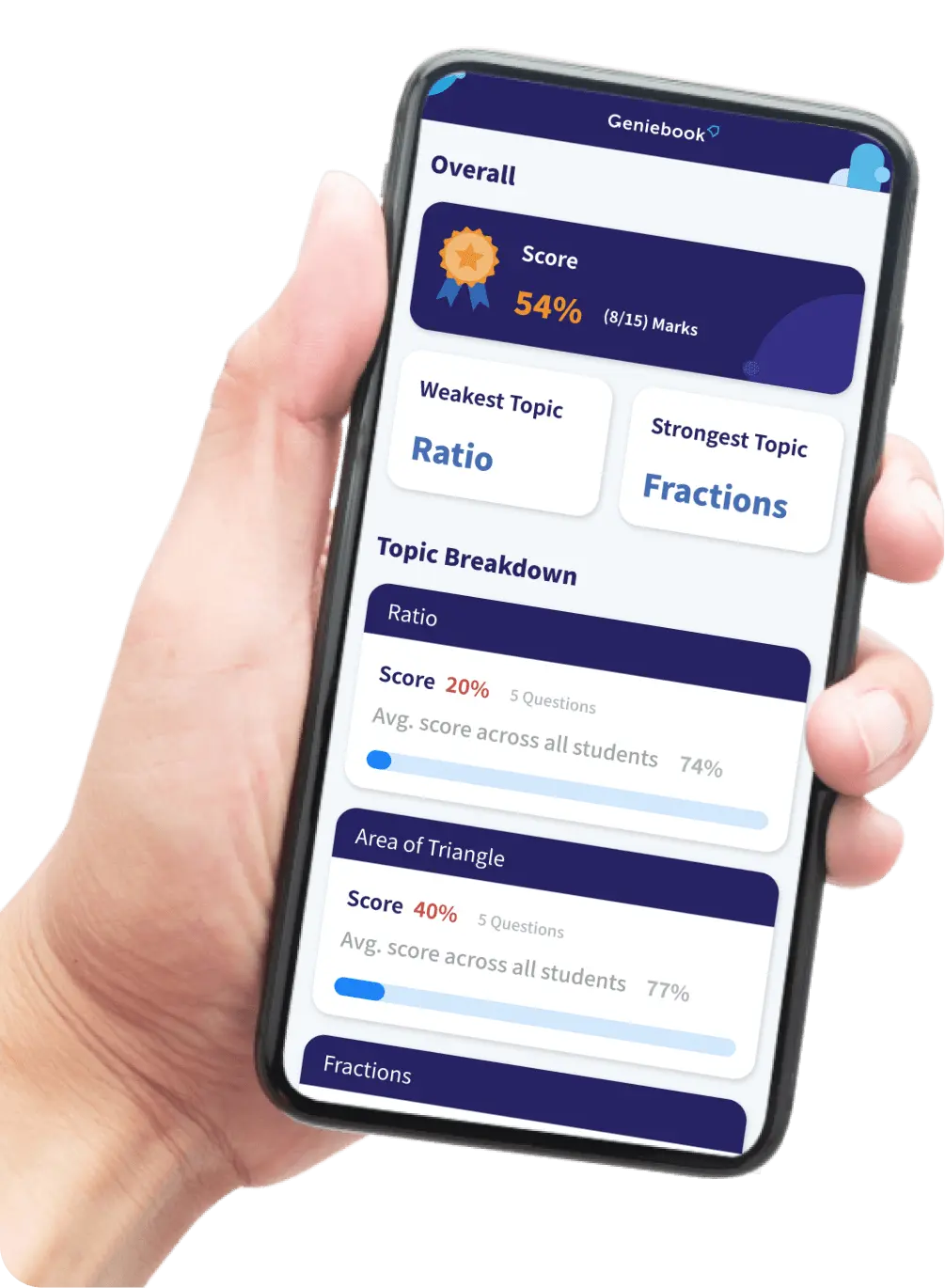
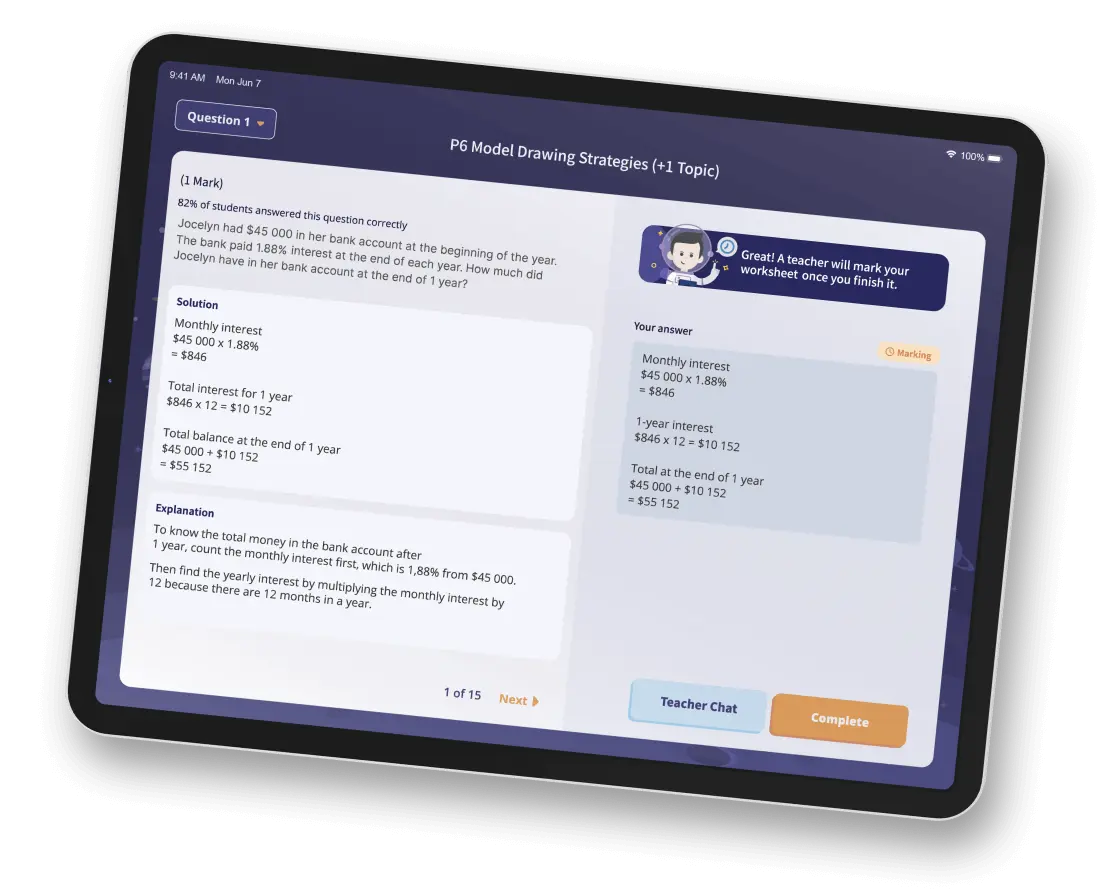
Through GenieSmart, our AI-personalised worksheets recommend targeted practice questions strictly aligned with the MOE syllabus, with difficulty levels that constantly adjust to your child's mastery of each topic. With over 300,000 questions in our database, our proprietary AI algorithm leverages over 1,000,000 data points to identify strengths and learning gaps. On GenieClass, experienced educators, including MOE and NIE-trained teachers, lead weekly live online classes, explaining complex English grammar, synthesis rules and comprehension strategies using storytelling, live polls and interactive visual aids.
If your child has doubts or needs help with homework, they can clarify concepts instantly through our real-time teacher chat on GenieAsk, which offers continuous support seven days a week. Additionally, our unique rewards system motivates students to learn independently. As your child completes worksheets and participates in classes, they earn Bubbles that can be redeemed for over 5,000 exciting, kid-safe items from our Bubble Store, turning daily practice into a rewarding habit. With half of our students successfully achieving AL 1 to AL 3 in PSLE and jumping two grades on average, we believe our personalised pedagogy is highly effective in building academic confidence. Partner with Geniebook to help your child stay focused and on track for their upcoming examinations.