



PSLE English Writing: A Veteran Educator's Guide to 'Show, Don't Tell'
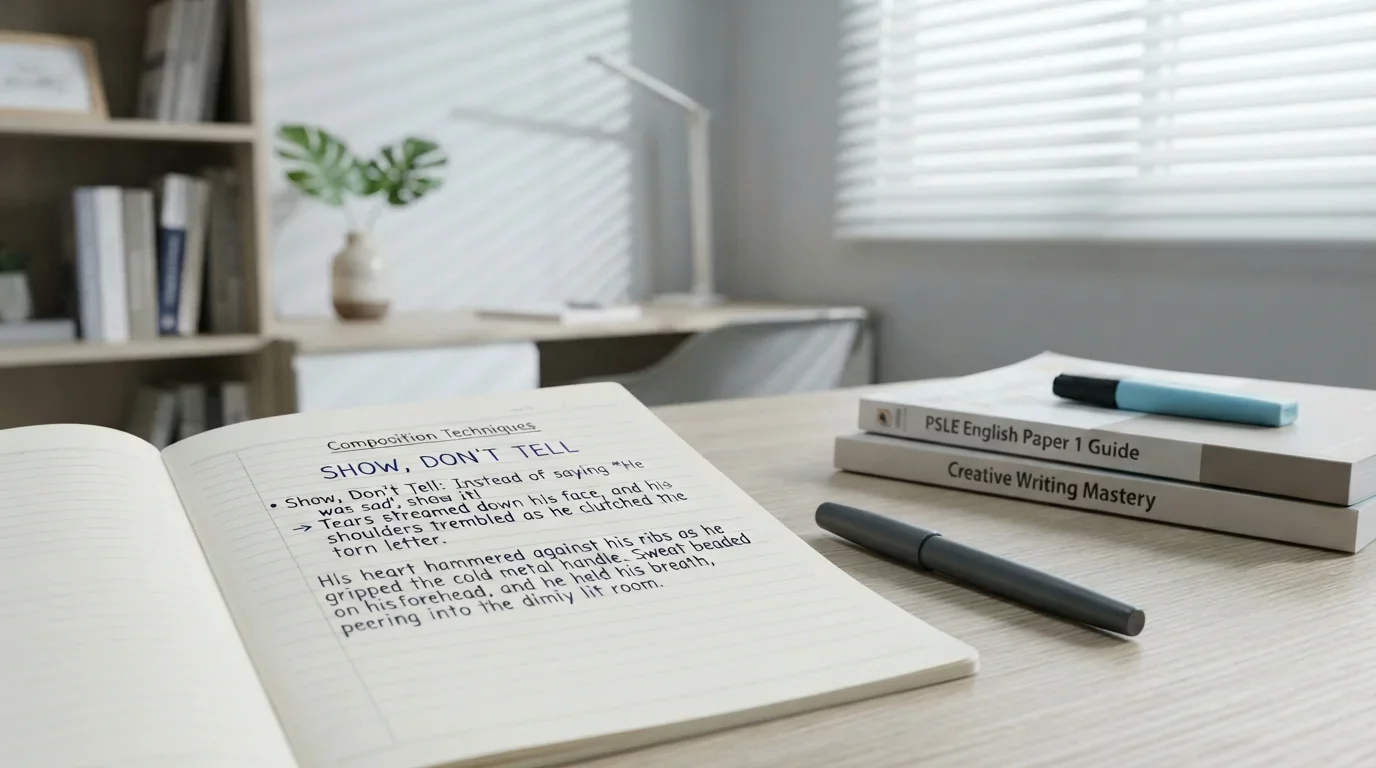
The Power of "Show, Don't Tell" in Primary English Compositions
We understand that helping your child navigate the primary school English syllabus and cope with the high-pressure PSLE English preparation can feel like an incredibly stressful and demanding experience for busy families in Singapore. Specifically, we observe that primary 5 and primary 6 students often struggle to express their ideas clearly in continuous writing and structure their compositions logically. We believe that by mastering structured writing workflows and choosing the right academic support, your child is fully empowered to close their learning gaps, stay on track and achieve their academic potential.
Why Flat Emotions Hurt Your Child's Expression Score
When examiners grade continuous writing in PSLE English Paper 1, they look closely at the 'Expression' rubric, which carries significant weight. Many primary school students write compositions filled with flat, simple statements of emotion. Telling the reader that a character was "sad" or "angry" or "happy" does little to engage the reader or demonstrate strong language control. Examiners prefer writing that shows flair and control, where emotions are vividly illustrated through a character's physical actions, facial expressions and internal thoughts.
By moving away from static vocabulary lists and learning to paint a picture with words, your child can elevate their narrative's rhythm and guide the examiner logically through the story arc. Shifting from telling to showing is a powerful exam technique that can make a dramatic difference to your child's grades.
How to Apply "Show, Don't Tell" in Continuous Writing
To help your child master this writing technique, guide them to break down emotions into physical symptoms and internal thoughts. This structured approach helps students express their reasoning clearly and logically under exam pressure. Here are three practical ways to turn flat, telling sentences into compelling, high-scoring descriptions:
1. Describe Physical Actions and Body Language
Instead of writing that a character was angry, describe what their body is doing. Clenched fists, a tightening jaw, pacing up and down or a sudden flush in the face tell the reader exactly how the character feels without ever using the word "angry". For example, instead of writing "John was angry", your child can write "John clenched his fists, his face flushing red as he glared at the broken toy." This level of detail shows a strong command of the language and builds character depth.
2. Focus on Facial Expressions and Sensory Details
Faces are incredibly expressive. Instruct your child to observe facial reactions. Wide eyes, a trembling lip, a raised brow or a radiant smile paint a clear picture. Instead of telling the examiner "Siti was scared", a showing sentence would be "Siti's eyes widened and her hands began to tremble as the mysterious shadow crept closer." This active description creates suspense and draws the reader into the story.
3. Reveal Internal Thoughts and Feelings
What is the character thinking? Internal monologue is a fantastic way to show emotion. When a character's heart is thumping or their mind is racing with questions, the reader immediately understands their anxiety. Instead of writing "He was nervous", write "He stared at the blank paper, his heart thumping against his ribs as he wondered if he would ever finish on time." This approach makes the character relatable and the narrative more impactful.
A Quick Comparison of Telling vs Showing
To help your child practice this routine at home, compare these classic exam examples:
| Telling (flat attempt) | Showing (scoring structure) |
|---|---|
| She was very happy. | Her face lit up with a brilliant smile and she beamed with joy. |
| He felt extremely nervous. | He paced back and forth, cold sweat trickling down his neck as he gripped his pencil tightly. |
| The old man was tired. | The old man slumped into his armchair, sighing deeply as his eyelids fluttered closed. |
By systematically auditing their drafts and replacing flat, telling statements with descriptive actions, students build the necessary muscle memory for recurring writing patterns, a key skill drilled in specialised primary English tuition.
Setting the Scene With Sensory Descriptions
While showing emotions is a vital part of continuous writing, many students forget that settings also need the "Show, Don't Tell" treatment. When introducing a scene, a typical student response often relies on a simple statement such as "It was a rainy afternoon" or "The classroom was very noisy". While these sentences convey basic facts, they fail to immerse the examiner in the story or establish a compelling mood. To secure top marks under the 'Expression' rubric, primary school students must learn how to build atmosphere by appealing to the reader's senses.
Using sensory details to bring settings to life is a highly effective way to create suspense, convey excitement or signal a turning point in the plot. It helps students transition smoothly between different parts of their story arc, transforming a basic narrative into a rich, immersive experience.
The Five Senses Framework for Atmospheric Writing
To help your child move away from flat settings, encourage them to use the five senses framework during their planning stage. By deliberately selecting sensory details, students can paint a vivid picture that immediately engages the reader. Here are three key senses that are particularly powerful in primary English compositions:
1. Incorporating Soundscapes to Build Mood
Sounds can instantly tell a reader what is happening without explicit explanation. In a busy school canteen, the clatter of plastic trays, the hum of excited chatter and the occasional burst of laughter immediately convey a lively atmosphere. In contrast, a suspenseful scene can be heightened by the ticking of a wall clock, the soft creak of a floorboard or the rustle of leaves. Teaching students to describe what characters hear is a major focus of specialised primary science and English tuition programmes, helping them create realistic backdrops for their characters.
2. Using Touch and Temperature to Signal Change
Sensations of touch and temperature are fantastic tools for creating physical discomfort or relief. Describing a sudden gust of chilly wind, the sticky feeling of sweat trickling down a forehead or the rough texture of a rusty gate builds immediate physical context. For example, instead of writing "It was a hot day", your child can write "The scorching afternoon sun beat down mercilessly, baking the concrete pavement and causing waves of heat to rise from the ground." This helps the reader feel the environment alongside the protagonist.
3. Appealing to Smell to Evoke Memory and Emotion
Smell is one of the most evocative senses. The aroma of freshly baked bread can create a warm, comforting atmosphere, while the damp, musty odour of an abandoned storeroom can trigger a sense of unease. Incorporating subtle scents into a description adds a layer of sophistication to a student's writing, helping them secure maximum marks for expression under timed conditions.
A Comparison of Telling vs Sensory Showing
To help your child understand how to apply this technique during their independent revision, review these contrasting examples of setting descriptions:
| Telling (flat description) | Showing (sensory description) |
|---|---|
| The science laboratory was quiet. | A heavy silence hung over the room, broken only by the soft hum of the air-conditioner and the occasional drip of a tap. |
| The market was very crowded and noisy. | The bustling wet market was a sensory overload, filled with the loud shouting of fishmongers, the sharp smell of fresh seafood and the constant jostling of early shoppers. |
| It started to rain heavily. | Dark clouds bruised the evening sky before a sudden clap of thunder shattered the air, releasing a torrential downpour that splattered loudly against the windows. |
By practising this sensory framework at home, your child will learn to treat settings as active elements of their storytelling, turning a routine writing task into a highly engaging piece of creative writing.
Balancing Showing and Telling Under Exam Conditions
Once primary school students learn the power of the "Show, Don't Tell" technique, they often fall into a common writing pitfall: over-showing. In their eagerness to impress the examiner, some students try to show every single action, setting and object in their composition. They write lengthy, tedious descriptions of trivial movements, such as a character opening a door or packing a school bag. This slows the narrative pace to a crawl and tires the reader. To secure top marks in PSLE English Paper 1, students must understand that "telling" is not a mistake. Rather, it is a vital tool that must be balanced strategically with "showing" to maintain a compelling story flow.
The secret to an AL 1 composition is knowing when to show and when to tell. Top-performing students follow a simple rule of thumb: show the peaks of the story and tell the valleys. This ensures that the most important emotional and climactic moments stand out clearly, while routine events are passed over quickly.
When to Use "Telling" for Strategic Transitions
Telling is essential for managing the narrative pace, summarizing routine actions and indicating the passage of time. If a student tries to show every detail of a character's journey to school, they waste precious time and words on minor events. Instead, they should use telling to transition smoothly between key scenes. Here are three scenarios where telling is the correct choice:
- Indicating the Passage of Time: Simple phrases like "Three years passed" or "After a few hours of intense study" are perfectly acceptable and highly efficient.
- Summarizing Routine Actions: Writing "He took the bus to the library" is far better than describing every stop, passenger and turn of the bus ride, unless a key plot point occurs during the journey.
- Setting Up Minor Details: If a character simply needs to have a pen, writing "He took out his pen" is sufficient. There is no need to write a descriptive paragraph about the plastic casing or the ink flow of a routine writing instrument.
When to Unleash "Showing" for Maximum Impact
Showing should be reserved for the high-impact elements of your child's composition. These are the moments where the reader needs to be fully immersed in the character's experience. Guide your child to focus their showing efforts on these three critical areas of their story arc:
- The Climax or Conflict: When the main problem of the story occurs, showing the character's physical panic, racing thoughts and fast-paced actions builds suspense and keeps the examiner engaged.
- Key Emotional Turning Points: Whether a character is experiencing deep regret, overwhelming relief or sudden anger, these emotions must be shown vividly using physical symptoms and internal monologues.
- The Resolution and Reflection: At the end of the story, showing a quiet moment of realisation or a change in behavior is far more powerful than simply telling the reader that the character "learnt a lesson".
A Comparison of Over-Showing, Telling and Balanced Writing
To help your child understand how to build a well-paced story during their independent revision, compare these three approaches to the same scene:
| Over-Showing (too slow) | Telling Only (too flat) | Balanced Writing (scoring structure) |
|---|---|---|
| He lifted his right hand. He placed his palm on the metal doorknob, feeling its cold, brass surface. He rotated his wrist clockwise. He pulled the heavy wooden door open and walked inside. | He was very scared, so he quickly went inside the room and locked the door behind him. | Terrified, he sprinted into the room and slammed the door shut. He slumped against the wooden panel, his chest heaving as he listened to his racing heartbeat in the dark. |
By practising this balancing act at home, your child will learn to treat their writing as a structured craft, ensuring they use their exam time and word count efficiently to maximize their scores, a crucial skill drilled in specialised primary English tuition.
Achieve academic goals with Geniebook's tech-enabled suite
At Geniebook, our suite of online learning products is designed to complement your child's primary school preparation, helping primary and secondary school students learn smarter, stay on track and do better. We believe that when technology supports experienced educators, your child is fully empowered to close their learning gaps and achieve their academic potential.
Through GenieSmart, our AI-personalised worksheets recommend targeted practice questions strictly aligned with the MOE syllabus, with difficulty levels that constantly adjust to your child's mastery of each topic. With over 300,000 questions in our database, our proprietary AI algorithm leverages over 1,000,000 data points to identify strengths and learning gaps. On GenieClass, experienced educators lead weekly live online classes, explaining complex English grammar, composition structures and answering techniques using storytelling, live polls and interactive demonstrations.
If your child has doubts or needs help with homework, they can clarify concepts instantly through our real-time teacher chat on GenieAsk, which offers continuous support seven days a week. Additionally, our unique rewards system motivates students to learn independently. As your child completes worksheets and participates in classes, they earn Bubbles that can be redeemed for over 5,000 exciting, kid-safe items from our Bubble Store, turning daily practice into a rewarding habit. With half of our students successfully achieving AL 1 to AL 3 in PSLE and jumping two grades on average, we believe our personalised pedagogy is highly effective in building academic confidence. Partner with Geniebook to help your child stay focused and on track for their upcoming examinations.