PSLE Listening Skills: The Note-Taking Mistake That Lowers Scores
PSLE Listening Skills: The Note-Taking Mistake That Lowers Scores
The most common mistake Primary 5 and Primary 6 students make in PSLE Listening Comprehension is trying to write down everything they hear. This 'more is more' approach often backfires, turning a listening test into a frantic transcription race that hinders real understanding. A smarter strategy focuses on selective note-taking and active listening, a crucial skill for both English and Mother Tongue papers, which is often honed through specialised programmes like primary Chinese tuition.
With the Listening component contributing 10% to the overall English result, fixing this one habit can make a tangible difference to your child's final PSLE score.
Why Is 'Writing Everything Down' a Failing Strategy?
The belief that a complete transcript leads to perfect marks is a persistent myth. This method, which I call 'attempt-driven note-taking', forces a child to race against the speaker. Instead of absorbing the context, they're focused on catching the next word. This almost always results in them falling behind the audio.
When this happens, they miss crucial transitions, key details and the overall message. The mental energy spent on writing distracts from the primary task: listening and comprehending. It’s an exhausting and inefficient way to approach the exam.
What Should My Child Do Before the Audio Plays?
The most powerful strategy begins before a single word is spoken: pre-reading the questions. The short time given before the audio starts is invaluable. Coach your child to use this period to scan the questions and multiple-choice options.
This simple act achieves two critical goals:
-
It sets a purpose for listening: Your child now knows what information to look for: is it a name, a time, a place or a reason?
-
It turns passive listening into active listening: Instead of waiting for information to arrive, they are actively hunting for specific details they know they need.
How Should My Child Take Notes During the Audio?
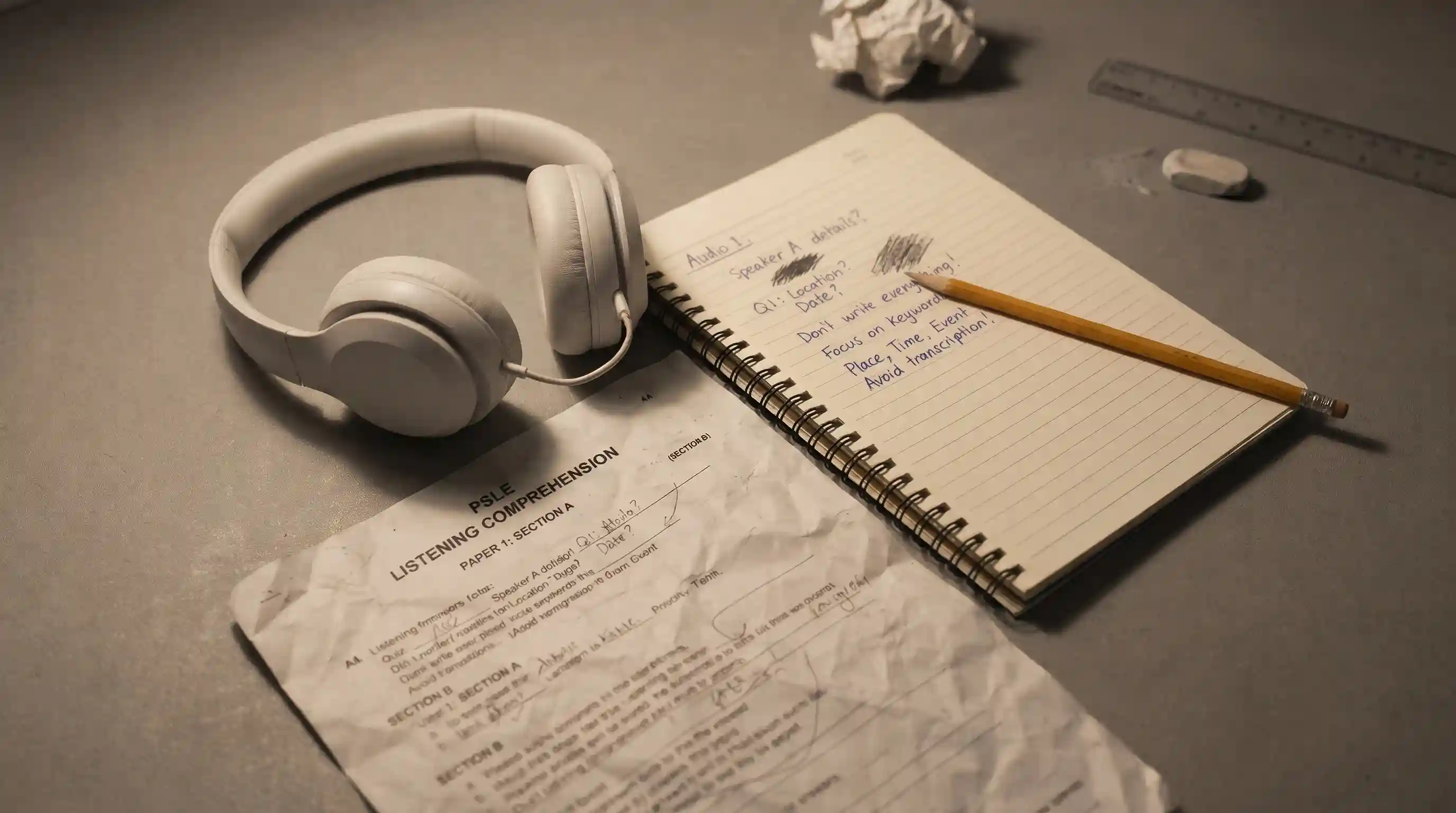
The key is to be selective and focus only on keywords. Forget full sentences. The goal is to capture essential information that directly answers the questions previewed.
Students should jot down:
-
Names: people and places
-
Dates: and times
-
Important instructions: or sequences
-
Keywords: that match the questions
For the English paper, a useful framework is the 'three-box method', where a child quickly divides their paper into sections for ‘Who/When/Where’. This organises information for quick retrieval. This keyword-centric approach is language-agnostic. Whether for English or a Mother Tongue, the principle is the same. In our experience with primary Chinese tuition, students who focus on capturing key nouns, verbs and time markers consistently outperform those who try to write full sentences.
What Is the 'Two-Pass Listening' Strategy?
SEAB plays each audio text twice, and students must learn to use both opportunities strategically.
-
First Play: This is for active listening and taking quick, selective notes on critical points. Your child should try to answer as many questions as possible based on this first pass.
-
Second Play: This is for verification, not for a second round of frantic writing. Students should listen carefully to confirm their initial answers, paying close attention to sections they were unsure about. The golden rule here is to only change an answer if they are absolutely certain their first choice was wrong. Second-guessing often introduces errors.
Beyond Note-Taking: How Can We Build Stronger Listening Skills at Home?
Consistent practice is vital but the nature of that practice matters. A 2023 Institute of Policy Studies (IPS) report highlighted rising parental stress, with 84.9% of parents believing tuition offers a PSLE advantage. While support is crucial, the focus should be on effective methods, not just more hours.
Here are a few ways to build these skills without adding to the pressure:
-
Conduct Mistake Analysis: After a practice paper, don't just mark it right or wrong. Ask your child why they chose an answer. What did they hear? What did they think it meant? This uncovers flawed listening habits and 'trap types' they might be falling for. A well-structured online tuition platform can provide timed practices and guided mistake analysis, making this process more efficient.
-
Encourage Sustained Listening: Occasionally watch longer programmes or documentaries together without subtitles. This trains the ear to follow extended conversations and arguments.
-
Have Device-Free Conversations: Simple mealtime chats without the distraction of screens are powerful listening practice. It teaches children to focus on a speaker and respond thoughtfully.
Ultimately, transforming your child's approach to the Listening Comprehension paper for PSLE 2027 is about shifting from frantic transcription to confident, strategic listening. By mastering these techniques, they can turn what was once a source of anxiety into an opportunity to secure valuable marks.
Frequently Asked Questions
Why is writing down everything I hear a bad idea during the PSLE listening exam?
Writing down everything you hear is ineffective because it turns the exam into a frantic transcription race that distracts you from understanding the actual message. When students focus on transcribing every word, they lose the mental energy required to comprehend context, leading to missed transitions and critical details that are necessary to answer the questions correctly.
What is the best way to take notes during the PSLE English listening comprehension?
The best way to take notes for PSLE English listening comprehension is to be selective and focus only on keywords rather than full sentences. You should train yourself to quickly capture essential information like names, dates, times and specific instructions, using a simple framework like the three-box method to organise details by category for easier retrieval.
How should I use the time before the audio plays in the listening paper?
You should use the time before the audio plays to actively pre-read the questions and multiple-choice options to set a specific purpose for your listening. By scanning the questions first, you know exactly what information you need to hunt for, such as a name, a time or a reason, which transforms passive waiting into active, targeted listening.
Is there a specific strategy for the two playbacks of the audio?
Yes, you should treat the first play as your primary opportunity for active listening and selective note-taking, while using the second play strictly for verifying your initial answers. The golden rule is to only change your answers during the second play if you are absolutely certain your first choice was incorrect, as unnecessary second-guessing often leads to errors.
How can I improve my PSLE listening skills at home without extra tuition?
You can improve your listening skills at home by conducting mistake analysis on your practice papers, watching longer documentaries or programmes without subtitles, and engaging in device-free conversations. Focusing on why a particular answer was wrong during practice sessions, rather than just marking it right or wrong, is one of the most effective forms of PSLE preparation for building consistent listening habits.