


PSLE Spatial Visualization: Tackling Geometry
Why Your Child Freezes at PSLE Geometry Questions
Many Primary 5 and 6 students find PSLE Maths geometry, especially questions on spatial visualisation, incredibly challenging. This skill, which involves mentally rotating and manipulating shapes, is crucial for tackling problems on nets, 3D views and area but is a major hurdle for many students even with good primary maths tuition.
Unlike other topics that rely on procedures and formulas, spatial reasoning requires a student to ‘see’ the solution in their mind. This cognitive leap from a 2D drawing on an exam paper to a 3D object is where marks are often lost in PSLE Paper 2. It’s a skill that extends far beyond the exam hall. Research consistently shows that strong spatial skills correlate with improved problem-solving abilities in STEM fields like engineering and physics.
Is Spatial Visualisation a Talent or a Trainable Skill?
It’s easy to assume some children are just “naturally good” at seeing shapes. While aptitude varies, spatial visualisation is absolutely a skill that can be trained and improved. In fact, one randomised control trial with 287 Grade 4 students found that just 40 minutes of digital spatial training per week over fourteen weeks led to significant gains in visual-spatial geometry performance.
The key isn't just more practice. It's about the *right kind* of practice. This is where parents and educators can make a huge difference, moving beyond rote learning to build genuine understanding.
Proven Strategies to Help Your Child Master PSLE Geometry
Before looking for PSLE math tuition, try these foundational, hands-on strategies at home. They are designed to make abstract concepts concrete and build your child's confidence.
Start with Hands-On Practice (The Cutting Technique)
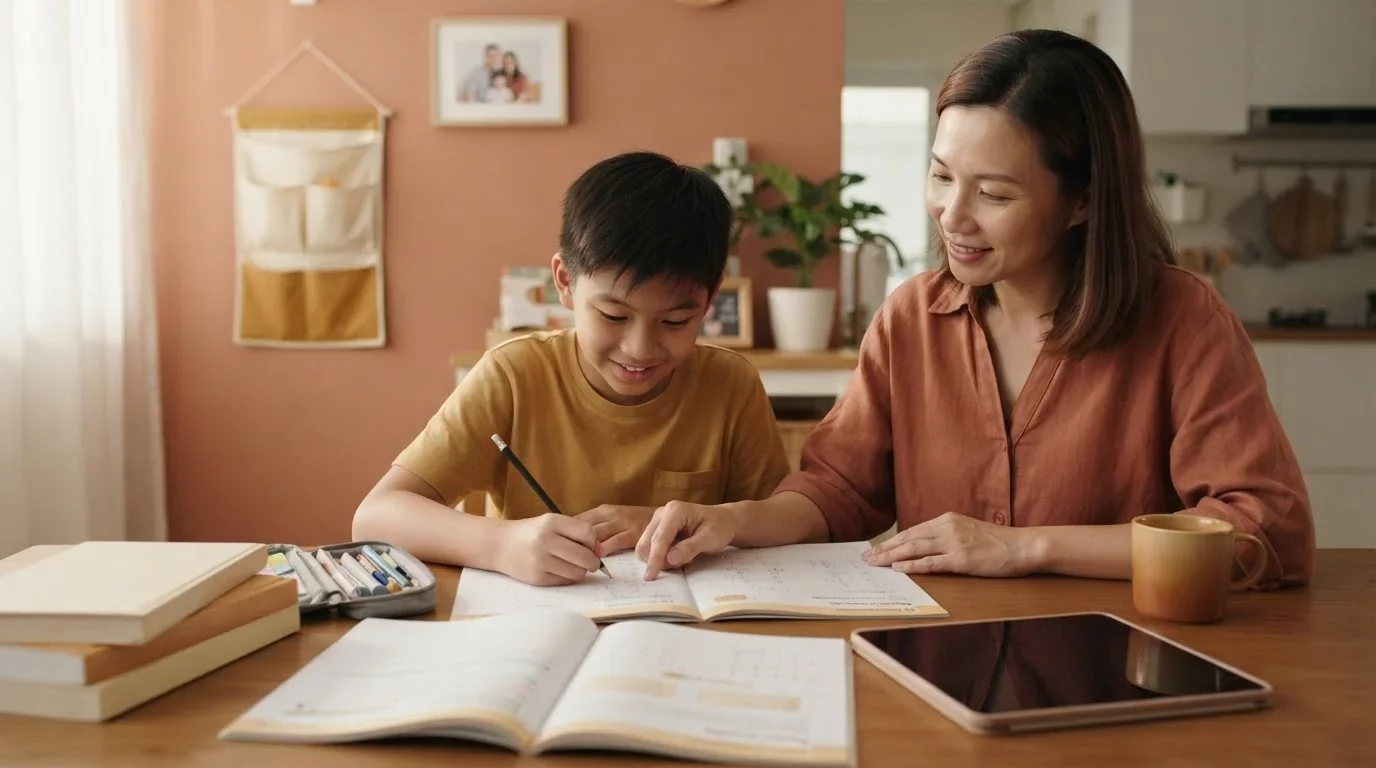
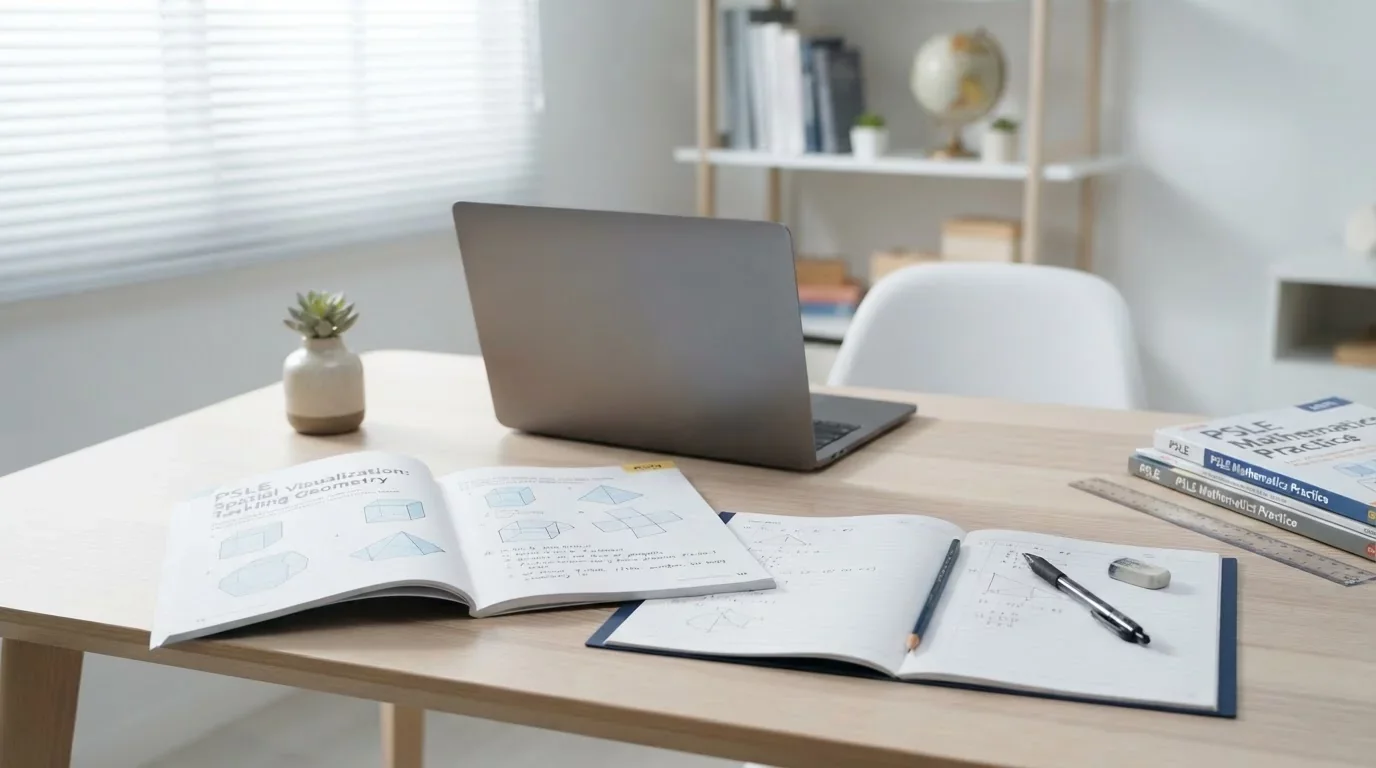
Get physical. One of the most effective methods is to use paper models. Print out different nets of cubes and cuboids, have your child cut them out and fold them. This physical manipulation directly connects the 2D net to the 3D shape, building an intuitive understanding that a drawing alone cannot provide. Use empty cereal boxes or tissue boxes to demonstrate how real-world objects unfold into flat patterns.
Master the Mock Diagram
Encourage your child to always draw and annotate diagrams. For complex area problems involving overlapping shapes, teach them to break the figure down. Can they redraw the shape in parts? Can they move a shaded part to a different location to form a simple square or rectangle? This act of re-drawing the problem is a powerful problem-solving heuristic that is fundamental to the MOE syllabus.
Ask, Don't Just Explain
When your child gets stuck, your instinct might be to show them the steps. However, as Singapore Maths experts note, simply explaining the solution is “probably not the best technique.” Instead, use scaffolding questions:
- “What is the first thing you notice about this shape?”
- “If you were to cut this figure, where would you make the first cut?”
- “Which basic shape (square, triangle, circle) do you see inside the bigger shape?”
This approach guides them to find the solution path themselves, building critical thinking instead of dependence.
How Can Tuition Help with Spatial Skills?
For many parents, the next step is seeking external support. Reports highlight that parents often choose tuition for more personalised attention, a concern especially valid for a skill as nuanced as spatial reasoning.
Choosing Good Primary Maths Tuition
A good primary maths tuition programme, whether for P4 or P6, should do more than just drill past papers. It should incorporate specific training for spatial skills. When evaluating a PSLE Maths tuition centre, ask how they teach topics like nets and 3D solids. Do they use manipulatives, digital tools or just worksheets? This is a key differentiator. The goal for a P6 maths tuition programme is to build the visual fluency needed for the high-stakes PSLE questions.
The Rise of AI-Powered Online Tuition
The tuition landscape is changing. Traditional private tuition can be a significant expense, with some families reporting costs of S\$1,500 a month. As a result, many are turning to more affordable and flexible options. Platforms offering Online Tuition are gaining traction, with some AI-driven tutors costing as little as S\$49 a month, as reported in local news outlets.
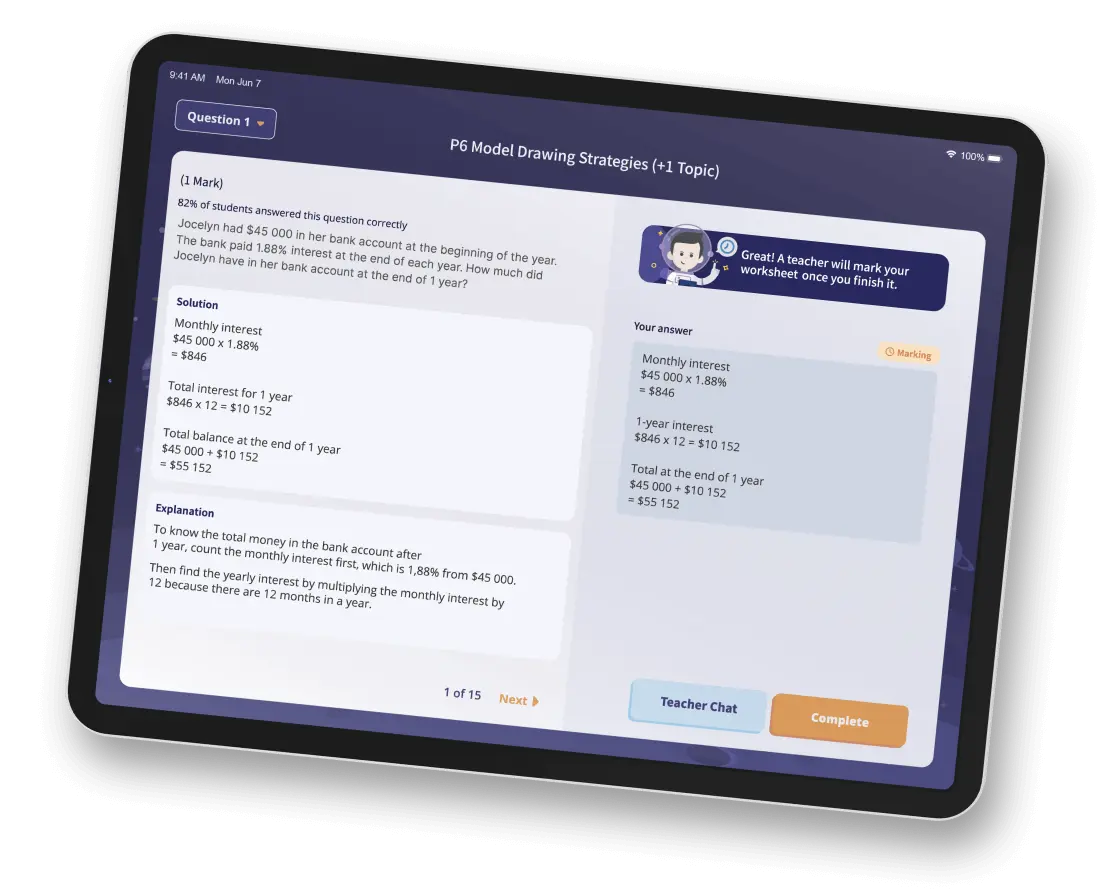
These platforms can offer unique advantages for geometry. Modern systems allow students to virtually interact with 3D models, rotating and zooming in on them in a way that static worksheets cannot replicate. This aligns with research highlighting the effectiveness of semi-immersive virtual training for improving mental rotation abilities.
A 4-Week Plan to Build Spatial Skills at Home
Use this simple checklist to integrate spatial practice into your child's routine:
- Week 1: Use LEGO or building blocks to construct 3D models based on 2D top, front and side view drawings from an assessment book.
- Week 2: Focus on nets. Gather three small household boxes (e.g. a toothpaste box, a small gift box). Predict what their nets will look like, then carefully unfold them to check.
- Week 3: Practice the ‘Cut and Move’ technique for area problems. Using questions from past-year papers, physically cut out the shaded parts on a copy and rearrange them to form simpler shapes.
- Week 4: Introduce digital tools. Use a free online cube-counting game or explore an Online Tuition platform with interactive 3D geometry modules.
Mastering spatial visualisation takes patience and consistent effort. It's a skill that unlocks not just higher marks in PSLE Maths but also a deeper, more intuitive understanding of the world. By combining hands-on methods with smart, targeted practice, you can help your child transform from a student who fears geometry into one who confidently tackles it.
Frequently Asked Questions
-
Why Do So Many Students Find PSLE Geometry Questions Difficult?
Many students find PSLE geometry questions difficult because they require strong spatial visualisation, which is the ability to mentally manipulate 2D drawings into 3D objects. Unlike other topics that rely on formulas, success in geometry often depends on this cognitive leap from a flat page to a three-dimensional shape, which is a common hurdle in PSLE Paper 2.
-
Is Spatial Visualisation a Talent or Can My Child Learn It for PSLE Maths?
Spatial visualisation is a trainable skill that any child can learn and improve for PSLE Maths with the right practice. While natural aptitude can vary, the article highlights research showing that consistent, targeted training leads to significant gains in visual-geometry performance, proving it is not just an innate talent.
-
What Should I Look for in a Good Primary Maths Tuition for Tackling Geometry?
A good primary maths tuition programme for geometry should incorporate specific training for spatial skills using hands-on or digital tools, not just worksheets. When evaluating a PSLE Maths tuition centre, you should ask if their curriculum for Primary 5 Maths tuition or Primary 6 maths tuition includes activities with manipulatives and interactive 3D models to teach concepts like nets and solids.
-
How Can I Improve My Child's PSLE Spatial Skills Without Tuition?
You can improve your child's PSLE spatial skills without tuition by using physical, hands-on methods at home to make abstract concepts concrete. The article suggests effective strategies like having your child cut out and fold paper nets, deconstruct household boxes and use building blocks to create 3D models from 2D drawings.
-
Is Online Tuition Effective for Learning PSLE Geometry?
Online Tuition can be a very effective and affordable option for learning PSLE geometry, particularly for building spatial visualisation skills. As the article notes, modern online platforms allow students to virtually interact with and rotate 3D models, offering a dynamic learning experience that static worksheets cannot replicate.