Common Science Misconceptions That Cost Marks in PSLE 2027: What Examiners Really Look For
Why Your Child Knows The Science But Still Loses Marks
The most common frustration I hear from parents is this: “My child studied so hard and understands the topic, but the marks just don’t show it. Was it carelessness?” After decades in this field, I can tell you the answer is almost always no. The biggest culprit for lost marks in PSLE Science is not carelessness, for it is a handful of stubborn, deep-seated content misconceptions combined with answers that lack the precision SEAB examiners are trained to look for. Identifying and correcting these is a core focus of effective primary science tuition. Many parents find that structured online tuition can be particularly good at diagnosing these hidden gaps before they become a major problem.
It’s a subtle but critical distinction. A child who is careless makes random errors. A child with a misconception will make the same mistake confidently, repeatedly, because their foundational understanding is flawed. The good news is that these misconceptions are entirely fixable. Fixing even one can unlock marks across both Booklet A and Booklet B.
The Top 3 Misconceptions That Surface Every Year
While the syllabus covers a wide range of topics, misconceptions tend to cluster in high-weightage areas like Energy, Cycles and Interactions. Here are three of the most damaging ones I see year after year.
1. The Plant Food Myth: “Plants get their food from the soil.” This is arguably the most common and costly misconception in primary science. It seems logical, but it’s fundamentally incorrect and will result in zero marks for related open-ended questions.
- The Scientific Truth: Plants make their own food, which is glucose (a type of sugar). They do this through a process called photosynthesis. The roots absorb water and mineral salts, but these are not considered 'food'. Food provides energy, and plants create their own energy source using sunlight.
- What Examiners Look For: A clear statement that plants make their own food. The use of key scientific terms like photosynthesis, sunlight, carbon dioxide and water. Answers must distinguish between 'food' (glucose) and what is absorbed by the roots ('water and mineral salts').
2. The Heat Myth: “Heat rises.” This is a dangerous oversimplification. While it describes an observation, it is not a scientific explanation. Using this phrase alone in an answer about heat transfer will not earn any marks.
- The Scientific Truth: When air or a liquid is heated, it expands, becomes less dense and then rises. The surrounding cooler, denser air or liquid sinks to take its place. The foundational rule is that matter expands when it gains heat and that heat flows from a hotter region to a colder region.
- What Examiners Look For: A complete, logical sequence using primary-level keywords. Marks are awarded for explaining the process using terms like gains heat, expands and rises.
3. The States of Matter Mix-Up: “Evaporation is boiling.” Students often confuse the different processes of state change, particularly evaporation and boiling. They are not the same, and questions are often designed to test this specific understanding.
- The Scientific Truth: Evaporation is the process where a liquid turns into a gas at any temperature, and it happens only at the surface of the liquid. Boiling happens at a specific temperature (the boiling point) and occurs throughout the entire liquid. Similarly, students must be clear that condensation is the process of water vapour (a gas) turning into water droplets (a liquid) upon contact with a cooler surface.
- What Examiners Look For: The correct use of terminology for the specific process described. For questions on condensation, a complete answer must mention that warmer air containing water vapour comes into contact with a cooler surface, loses heat and condenses to form water droplets.
What Do SEAB Examiners Really Want In Booklet B?
Knowing the content is only half the battle. Many students with perfect conceptual knowledge still score poorly in Booklet B because they fail to communicate their understanding in the way examiners require. The difference between an AL 1 and an AL 4 answer often comes down to these three things.
- Precise scientific keywords: Examiners scan for these. An answer without the correct terminology, even if the idea is generally right, will not score well. Missing keywords is a silent killer of marks.
- Structured explanations: Top-scoring answers follow a logical, cause-and-effect structure. Think of it as a three-step chain: State the observation or comparison → State the relevant scientific concept → Link the concept directly back to the observation.
- Application, not just recall: The PSLE paper is designed to test a student's ability to apply concepts to unfamiliar scenarios. This is where rote memorisation fails and a deep, true understanding shines.
3-Step Plan To Fix Misconceptions At Home
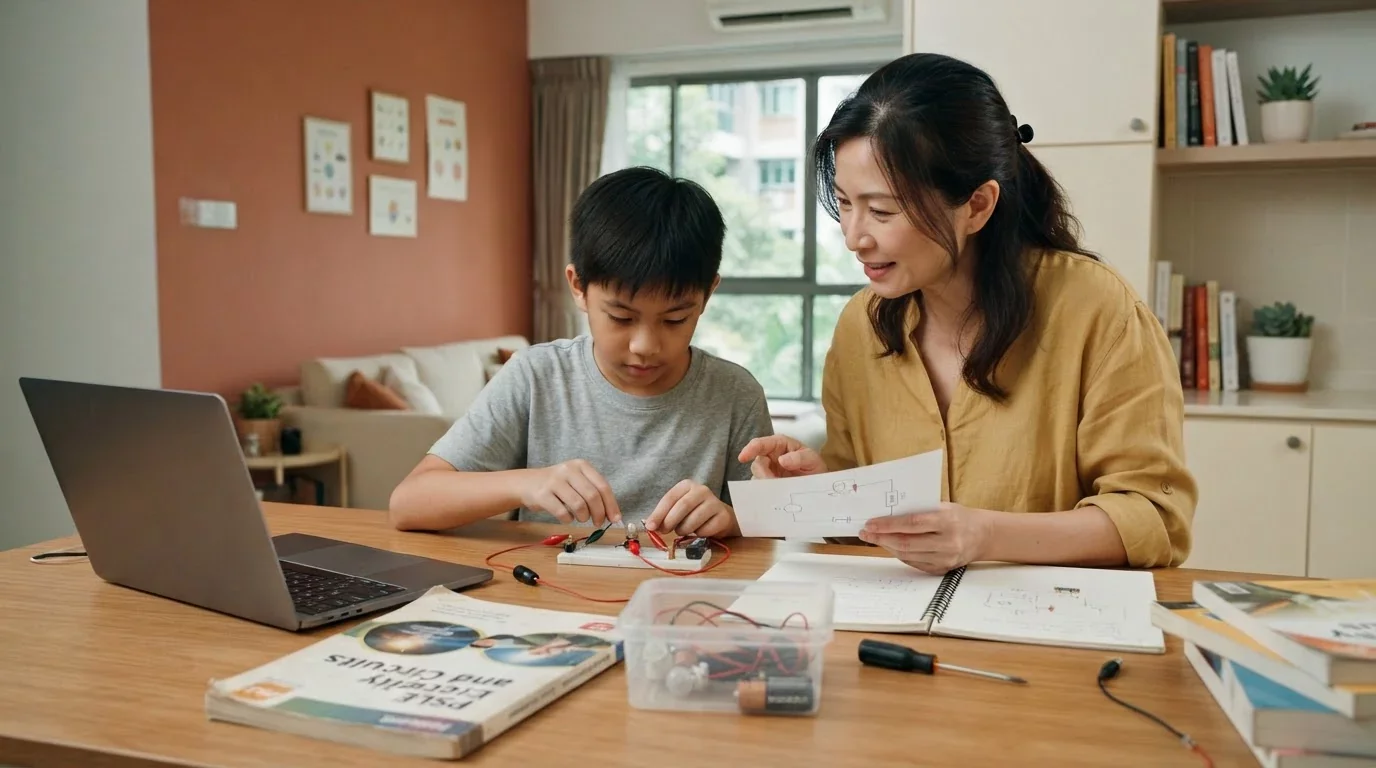
As a parent, you are in a unique position to spot these persistent errors. You don't need to be a science expert, you just need a strategy.
- Step 1: Use the “Teach-Back” method. Ask your child to explain a concept to you as if you know nothing about it. For example, “Can you explain the water cycle to me?” Listen for vague language or logical gaps. This method, often used by expert tutors, quickly reveals what a child does and doesn't truly understand.
- Step 2: Conduct a “Keyword audit”. Go through their past worksheets. Look at questions they got wrong. Did they use the correct keywords in their explanation? Often, the teacher’s red pen will have circled the exact spot where a term like “photosynthesis” or “convection” was missing. This is a common challenge for students entering primary 5, and a good primary science tuition programme will focus heavily on vocabulary.
- Step 3: Focus on answer structure. Instead of just re-doing a question, ask your child to rewrite their answer using the cause-and-effect framework. Having a reliable primary science tutor or a primary 6 science tuition class that drills this answering structure can make a tremendous difference in the final months before the exam.
Ultimately, tackling these misconceptions is not about endless drilling. It is about upgrading your child's mental model of how the world works. By shifting the focus from blaming carelessness to correcting specific content gaps, you build not just a better scientist, but a more confident learner. A structured revision plan, whether guided at home or through specialised primary science tuition, provides the clarity needed to turn these common errors into guaranteed marks for PSLE 2027.
Frequently Asked Questions
Why does my child understand the science concept but still lose marks in the PSLE?
Your child likely loses marks because they lack the precision SEAB examiners require or are holding onto persistent science misconceptions that lead to flawed answers. Even if a student understands the general idea, examiners specifically look for accurate scientific keywords and a structured, logical explanation. Addressing these hidden gaps in understanding is essential for improving results in PSLE 2027.
What are the most common science misconceptions that cause students to lose marks?
The most common science misconceptions include the belief that plants get food from soil instead of making it through photosynthesis, the oversimplified idea that heat simply rises rather than moving through convection currents, and the confusion between evaporation and boiling. Identifying and correcting these specific errors early in the primary science syllabus is crucial for avoiding recurring mistakes.
How should I structure a science answer to score better in Booklet B?
You should structure a science answer by using a three-step cause-and-effect framework: first state the observation or comparison, next state the relevant scientific concept and finally link that concept directly back to the observation. Examiners at the SEAB prioritise answers that demonstrate this logical flow and incorporate precise science keywords, rather than simple recall of facts.
How can I help my child fix their science misconceptions at home?
You can help your child by using the teach-back method, where they explain a concept to you to reveal any vague language or gaps in their logic. Additionally, conduct a keyword audit of their past marked worksheets to see where they failed to use the correct terminology, and encourage them to rewrite incorrect answers using the structured cause-and-effect format.
Does rote memorisation work for the PSLE science paper?
Rote memorisation is often insufficient for the PSLE science paper because the exam is designed to test a student's ability to apply concepts to unfamiliar, real-world scenarios. While knowing definitions is important, success depends on understanding how to apply science principles, which is a major focus of the current MOE syllabus.
What should I look for when checking my child's answer for science keywords?
When checking your child's answers, look for precise scientific terminology that matches the topic, such as using 'photosynthesis' when discussing plant food or 'convection current' when explaining heat transfer. Examiners scan for these specific terms, and omitting them can result in lost marks even if the underlying idea of the answer is correct.