


PSLE Science Open-Ended Questions: A 6-Week Plan Using Everyday Scenarios

Mastering the PSLE Science paper now hinges on one critical skill: applying concepts to unfamiliar, real-world situations. This practical 6-week home revision plan is designed for Primary 5 and Primary 6 students to turn everyday Singaporean life into a science lab, building the deep reasoning skills needed for high-quality open-ended explanations.
Why Rote Learning Is No Longer Enough for PSLE Science
For years, parents could rely on assessment books and memorisation. That era is over. The current MOE Science curriculum, reflected in recent PSLE papers, has decisively shifted towards testing inquiry and application. A student can memorise the entire textbook but still falter when asked to explain why condensation forms on the outside of a chilled can of Pokka Green Tea in our humid climate. These application-based, open-ended questions (OEQs) in Booklet B are where marks are most often lost.
Vague answers, mixing up concepts or failing to link cause and effect are common pitfalls. The exam doesn’t just want to know what your child knows. It wants to see how they think. This requires a different kind of preparation, one that builds scientific intuition and the ability to articulate clear, evidence-based arguments. Primary Science at Geniebook focuses on building this kind of application-based reasoning.
Your HDB Kitchen: The Ultimate Primary Science Tuition Lab
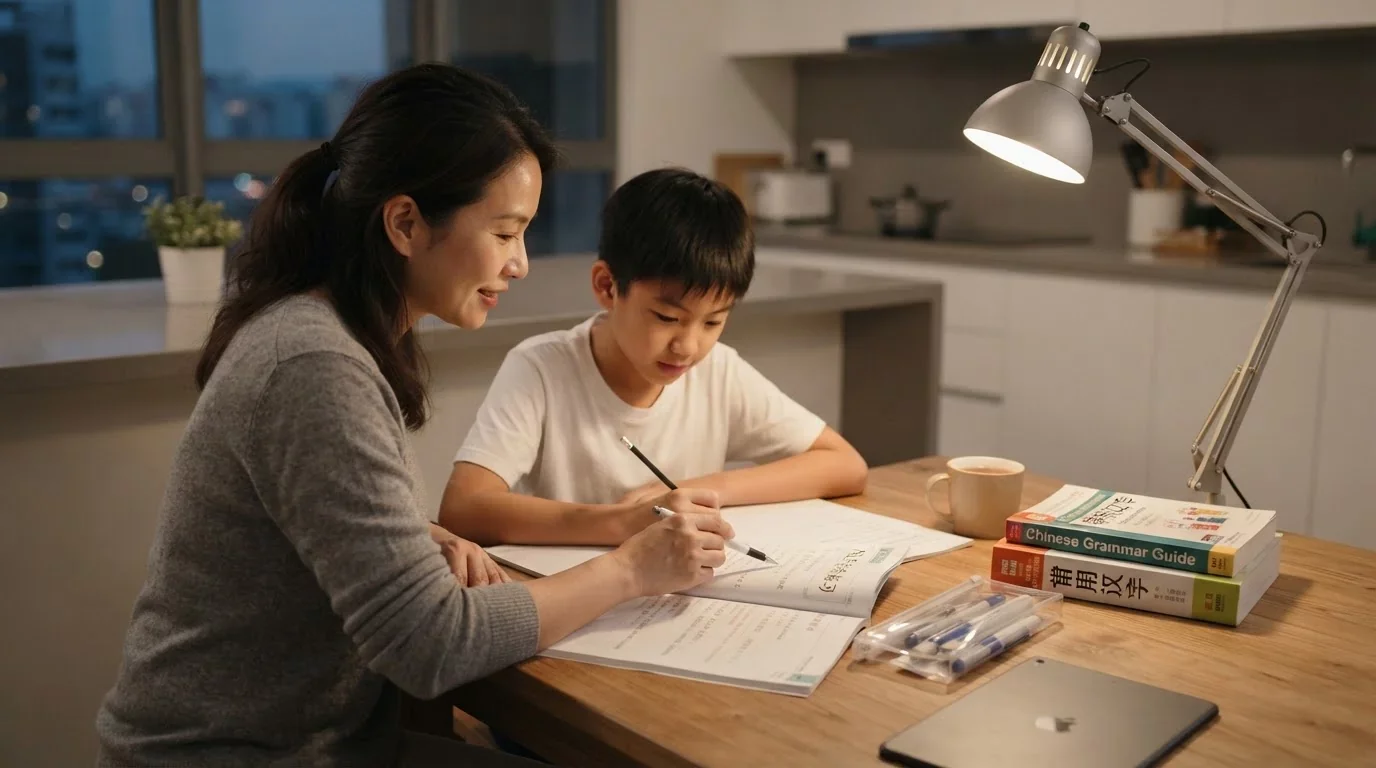
You do not need an expensive laboratory to build these skills. Your home is filled with scientific phenomena waiting to be explored. A simple home experiment approach makes learning tangible and directly addresses the MOE's focus on inquiry skills. It’s a low-cost, high-impact strategy that fosters genuine curiosity.
Think about it. The mould growing on a forgotten slice of bread demonstrates decomposition. The way a torchlight’s beam is blocked by different objects teaches the properties of light. These aren't just chores or daily occurrences. They are exam questions in disguise.
Everyday Singaporean Scenarios as PSLE Science Lessons
| Everyday Singaporean Scenario | PSLE Science Concept | Simple Question to Ask |
|---|---|---|
| Condensation on a cold drink can | Heat, Water Cycle, Matter | "Where does the water on the outside of the can come from?" |
| A puddle drying up at the void deck | Evaporation, Heat | "Why does the puddle disappear faster on a hot, windy day?" |
| Using a fridge magnet to hold a note. | Forces, Magnetism | "Will this magnet work through a thick calendar? Why or why not?" |
| Wilting plants on a hot afternoon | Life Cycles, Plant Systems | "What does the plant need that it's not getting enough of right now?" |
The 6-Week Home Revision Plan for PSLE Science Mastery
This plan focuses on consistency over intensity. Aim for two or three 45-minute sessions per week. The goal is to build a habit of scientific thinking, not to cram.
Weeks 1-2: Foundational Concepts and Keyword Precision
-
Focus: Solidify understanding of core Primary 3 to 5 topics (Cycles, Systems, Energy).
-
Activity: Start a “Science Diary”. Each day, observe one thing from the table above. Write one sentence describing what you see (Observation) and another explaining why it happens (Explanation).
-
Parent's Role: Review the diary. Challenge vague words. If your child writes “the water disappeared,” ask them to use the scientific term “evaporated.” This is crucial for exam answers.
Weeks 3-4: Cause, Effect and Evidence
-
Focus: Answering “Why?” questions using the Claim-Evidence-Reasoning (CER) framework. This is the backbone of a good open-ended answer.
-
Activity: Conduct a simple experiment. For example, place two identical wet cloths, one in a windy spot (e.g. near a fan) and one in a still spot.
-
Parent's Role: Ask your child to explain the result using CER. Claim: The cloth near the fan dried faster. Evidence: I observed that after 30 minutes, the cloth in the windy spot was dry while the other was still damp. Reasoning: The presence of wind increases the rate of evaporation.
Weeks 5-6: Tackling Unfamiliar Scenarios and 2-Mark Questions
-
Focus: Applying knowledge to complex, multi-concept questions from past PSLE papers.
-
Activity: Practise one open-ended question from a past-year paper daily. Focus on questions that present an unfamiliar setup or scenario.
-
Parent's Role: For 2-mark questions, ensure your child provides two clear, distinct points or one point explained with a cause and effect. For instance, an answer might require stating the scientific concept and then linking it to the observation in the question.
What If We Get Stuck? The Role of a Tutor and Online Support
Home revision is powerful but it's normal to hit a wall. Sometimes, a concept is just tricky or a PSLE question is worded in a confusing way. This is where targeted support becomes invaluable. The growing challenge of PSLE Science is even acknowledged by various community educational initiatives, which have enhanced their tuition schemes to include Science for Primary 4 to 6 students.
A good PSLE Science tutor can diagnose persistent misconceptions that home practice alone might not reveal. They have seen the common mistakes students make under exam pressure. For families looking for more immediate support, online tuition platforms offer new solutions. AI-powered tools like Geniebook's GenieAsk can analyse a question and provide a step-by-step explanation in minutes, clarifying doubts exactly when they arise. This combination of hands-on home practice and on-demand expert help is a modern and effective approach to Primary Science tuition.
Ultimately, the goal of this 6-week plan is to build your child's confidence and scientific reasoning. By connecting textbook concepts to the world they see every day, from the HDB corridor to the park connector, you empower them to walk into the exam hall ready to analyse, explain and excel.
Frequently Asked Questions
- Why is memorising the textbook not enough to pass PSLE Science?
Memorising the textbook is no longer enough for the PSLE Science exam because the current MOE curriculum has shifted to test a student's inquiry skills and their ability to apply concepts to unfamiliar, real-world situations. Students are expected to demonstrate how they think through a problem, not just recall facts.
- How can I help my child answer PSLE Science open-ended questions better?
You can help your child answer PSLE Science open-ended questions better by using a home-based approach that turns everyday scenarios into science lessons, helping them practise the Claim-Evidence-Reasoning (CER) framework. For example, discussing why a puddle dries faster on a hot day helps build the logical thinking required for high-quality explanations in Booklet B.
- What is a good home revision plan for P6 Science tuition?
A good home revision plan to supplement P6 Science tuition involves two or three 45-minute sessions weekly over six weeks, focusing first on keyword precision, then on cause-and-effect thinking and finally on tackling complex questions from past PSLE papers. This structured approach builds the reasoning skills needed for the exam without overwhelming the student.
- When should I get a Primary Science tutor for my child?
You should consider getting a Primary Science tutor if your child hits a wall with home revision and persistently struggles with certain concepts or confusing exam questions. A good tutor providing focused Primary Science tuition, whether for Science tuition for Primary 5 or Primary 6, can diagnose deep-rooted misconceptions and offer targeted support.
- Is online tuition useful for improving PSLE Science scores?
Yes, online tuition can be very useful for improving PSLE Science scores by offering immediate, on-demand support for students when they get stuck on a difficult question. Platforms with features like AI-powered tools can provide step-by-step explanations, clarifying doubts instantly and complementing a structured home revision plan.