PSLE Chinese Grammar: A Practical Walkthrough of 5 Key Sentence Patterns
PSLE Chinese Grammar: A Practical Walkthrough of 5 Key Sentence Patterns
Many parents feel that teaching PSLE Chinese grammar at home is a daunting task. The rules seem abstract and completely different from English, making it hard to explain why a sentence “just sounds wrong”. The key isn't to memorise a thick grammar textbook but to master a few fundamental sentence patterns that form the backbone of the language. This practical guide gives your child a tangible jumpstart, using one simple scenario to show how these patterns work, a method that complements the structured practice found in good primary Chinese tuition.
Why Does Chinese Sentence Structure Seem So Complicated?
The biggest hurdle for young learners is that Chinese grammar relies heavily on word order, not on changing the words themselves. Unlike in English where verbs change (eat, ate, eaten), the Chinese character 吃 (chī) remains the same. Meaning is created by where you place words in the sentence, especially words indicating time and place. Getting this wrong can completely change the meaning of a sentence.
The MOE syllabus and PSLE Chinese exam reflect this reality. They don't test obscure grammar rules in isolation. Instead, they assess a student's ability to understand and use correct sentence structures in comprehension passages and compositions. Understanding the logical patterns behind sentence construction is therefore more critical than rote memorisation.
The Family Picnic Method: Building Sentences Step-by-Step
Let's use a simple, relatable scenario: planning a family picnic. We'll build from a basic sentence and add complexity, showing how each grammar pattern works in a real context.
Step 1: The Basic Building Block (Subject-Verb-Object)
This is the most fundamental pattern in both English and Chinese. It answers the questions: Who did what to what?
-
Structure: Subject + Verb + Object
-
Example: 妈妈 准备 食物。 (Māmā zhǔnbèi shíwù.)
-
Translation: Mum prepares food.
Pro-tip for parents: When your child reads a sentence, get them into the habit of identifying these three core components. This is the foundation for understanding everything else.
Step 2: Adding When and Where (Time and Place Phrases)
Here is where Chinese word order starts to differ significantly from English. Time and place phrases almost always come before the verb.
-
Structure: Subject + Time + Place + Verb + Object
-
Example: 妈妈 明天 在家里 准备 食物。 (Māmā míngtiān zài jiālǐ zhǔnbèi shíwù.)
-
Translation: Mum tomorrow at home prepares food.
-
Common mistake: 妈妈 准备 食物 明天 在家里。 (Incorrect)
Step 3: Emphasising the Outcome With 把 (bǎ zì jù)
The 把 (bǎ) sentence is a high-frequency structure used to show what happened to an object or the result of an action. It pulls the object from the end of the sentence to a position before the verb.
-
Structure: Subject + 把 + Object + Verb + Result/Complement
-
Example: 妈妈 把 食物 准备好了。 (Māmā bǎ shíwù zhǔnbèi hǎo le.)
-
Translation: Mum has prepared the food. (The emphasis is on the food being dealt with and the action completed).
This pattern is crucial for adding descriptive detail and sophistication to compositions, moving beyond simple SVO sentences.
Step 4: Using the Passive Voice With 被 (bèi zì jù)
The 被 (bèi) construction is used when the subject of the sentence receives the action, similar to the passive voice in English.
-
Structure: Object + 被 + Doer + Verb + Complement
-
Example: 食物 被 妈妈 准备好了。 (Shíwù bèi māmā zhǔnbèi hǎo le.)
-
Translation: The food was prepared by Mum.
Sometimes, the 'doer' (妈妈) is unknown or unimportant and can be left out. For example: 食物被准备好了。(The food was prepared.)
Step 5: Linking Actions Together With 连动 (liándòng)
This pattern, also known as a serial verb construction, strings together two or more verbs in the logical order they occur. There is no 'and' between them.
-
Structure: Subject + Verb 1 (+ Object 1) + Verb 2 (+ Object 2)
-
Example: 妈妈 去 超市 买 食物。 (Māmā qù chāoshì mǎi shíwù.)
-
Translation: Mum goes to the supermarket to buy food. (The actions happen in sequence: first go, then buy).
How Can I Reinforce These Patterns at Home?
Understanding these patterns is the first step. Mastery comes from practice. Here are two simple strategies you can use at home:
-
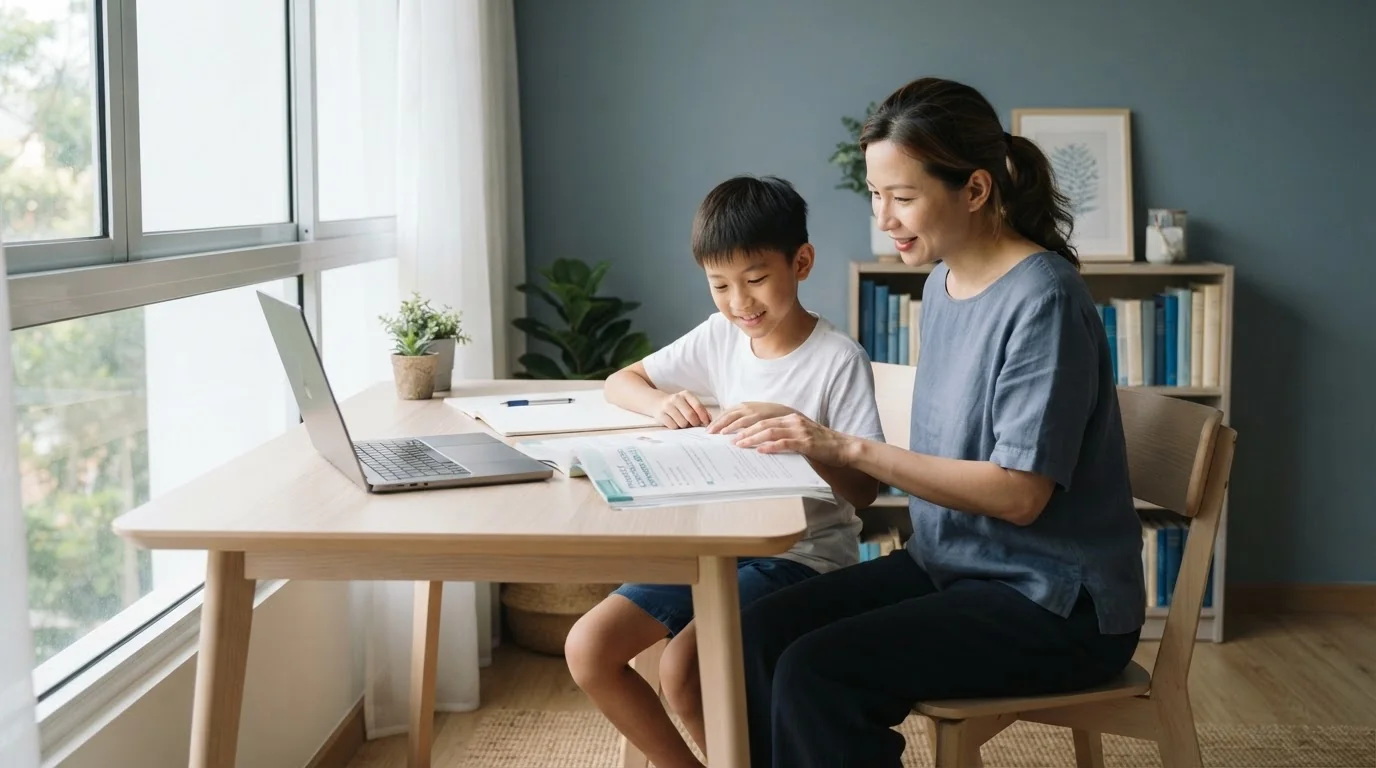
The sentence annotator: When reading a storybook or assessment book passage, give your child different coloured highlighters. Ask them to mark the Subject (who), Verb (action), Object (what), Time and Place. This simple visual exercise trains their brain to see the patterns automatically.
-
Rewrite and rephrase: Take a simple sentence from their reading. Ask them questions to transform it. “Can we rewrite this using 把?” or “What happens if we add 'yesterday' to this sentence? Where does it go?” This active recall is far more effective than passive reading.
While these home practices build a strong foundation, consistent application is key. A structured online tuition programme can provide targeted exercises and immediate feedback to solidify this pattern-recognition skill.
Is This Grammar Foundation Enough for PSLE?
Mastering these five sentence patterns provides a powerful foundation that significantly impacts both Paper 1 (Composition) and Paper 2 (Comprehension). It allows a child to write with greater clarity and accuracy while also decoding complex sentences in exam passages. However, it is just one piece of the PSLE puzzle.
Success in PSLE Chinese also requires a mastery of over 1,700 characters and more than 200 essential 成语 (chéngyǔ). This breadth of knowledge is built over years of consistent effort. Parental anxiety around the PSLE is understandable. A recent Institute of Policy Studies (IPS) report highlighted that a vast majority of parents (84.9%) believe tuition gives their child an advantage, with many worried about their children falling behind.
This is where professional help provides a critical edge. As noted by educators, tuition centres often provide practice on a scale that schools cannot, such as writing 40 compositions a year compared to just six in school. Whether through focused primary Chinese tuition or a flexible online tuition course, getting targeted support ensures your child builds the robust vocabulary and grammatical fluency needed to face the exam with confidence.
Ultimately, learning Chinese grammar isn’t about memorising abstract rules. It’s about recognising logical patterns. By starting with a simple scenario like a family picnic, you can demystify these structures and give your child a confident start on their path to PSLE success.
Frequently Asked Questions
Why do Chinese sentences seem harder to learn than English sentences?
Chinese sentence structure is often perceived as complicated because meaning is derived from word order rather than word conjugation. Unlike English where verbs change form to indicate tense or subject, Chinese characters typically remain the same, meaning that the position of words indicating time, place and the subject is strictly rigid and critical to retaining the correct meaning of the sentence.
What are the most important sentence patterns for PSLE Chinese students to master?
For the PSLE Chinese exam, students should focus on mastering five core sentence patterns: Subject-Verb-Object (SVO), sentences incorporating time and place, the bǎ zì jù (把) pattern, the bèi zì jù (被) passive voice pattern and the liándòng (连动) serial verb construction. Understanding these logical structures helps students improve both their composition writing and their comprehension of complex exam passages.
How can I help my child improve their Chinese composition using grammar techniques?
You can improve your child's composition skills by actively teaching them to identify and rephrase sentence patterns rather than relying on rote memorisation. Practical exercises like using different highlighters to annotate subjects, verbs and objects in reading passages, or asking them to transform a standard sentence into a bǎ zì jù or bèi zì jù construction, are effective ways to build grammatical fluency for the PSLE.
Is focusing on grammar enough to succeed in the PSLE Chinese exam?
While mastering PSLE Chinese grammar and essential sentence patterns provides a crucial foundation for clarity and accuracy, it is only one component of the exam requirements. Success also requires a broad vocabulary of over 1,700 characters and mastery of more than 200 essential chéngyǔ, alongside consistent practice in writing compositions and completing comprehension exercises.
How can Singapore Chinese tuition help with PSLE preparation?
Singapore Chinese tuition can help by providing targeted feedback and a higher volume of practice that schools may not be able to accommodate, such as writing dozens of compositions annually. Professional tutoring or structured online tuition programmes offer the consistent guidance needed to solidify pattern-recognition skills and build the vocabulary required to face the PSLE with confidence.